.png) Get Started
Get Started

Most founders underestimate how quickly support becomes a full-time problem. You launch, users start pouring in, Discord lights up, Telegram gets noisy, and suddenly half your day disappears into answering the same five questions on repeat. At that point, the question isn't whether to build a customer support team. It's why you waited so long.
This guide walks through the full progression: when to hire, how to structure your team, who to bring on, how to onboard them, which processes to build, and which tools actually fit the way community-driven companies operate.
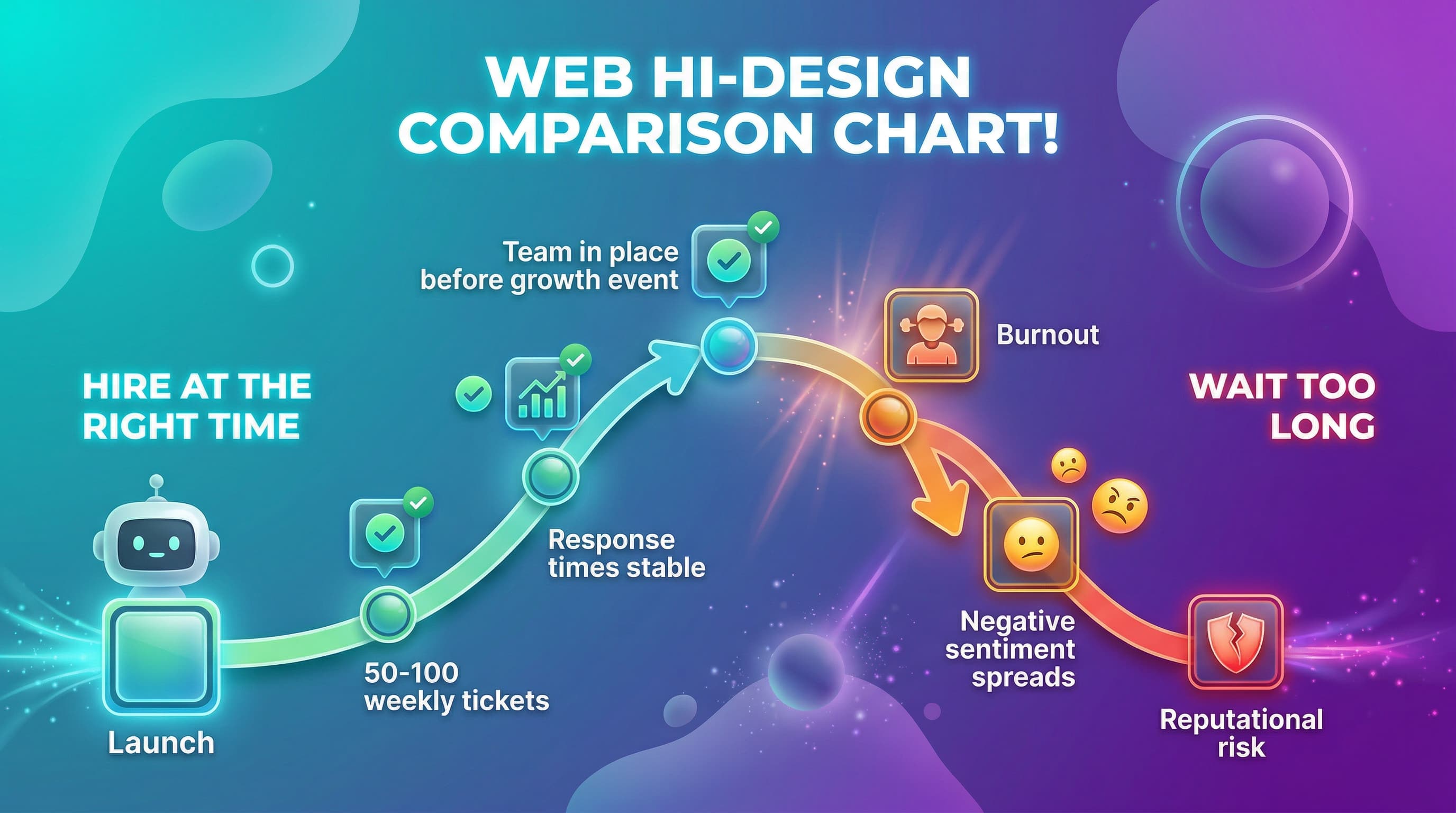
Timing matters. Hire too early and you're burning budget without enough volume to keep a rep sharp. Hire too late and you're doing damage control while simultaneously building a support function from scratch.
The clearest indicator is when weekly ticket volume across Discord, Telegram, and Slack exceeds 50-100 interactions and starts pulling you away from product work, or when response times stretch beyond 2-4 hours during peak community hours. If you're spending two hours a day fielding DMs, that's two hours not spent on product, fundraising, or hiring.
Growth events accelerate this curve fast. A new product launch, a token event, or rapid community expansion can double inbound volume overnight. Getting slightly ahead of that wave makes the transition significantly smoother.
Delayed support build-outs create reputational risk, not just operational stress. In community platforms like Discord and Telegram, negative sentiment spreads fast and publicly. Internally, support falling on whoever happens to be available creates burnout, erodes continuity, and drives turnover at exactly the moment you're trying to establish consistent processes.
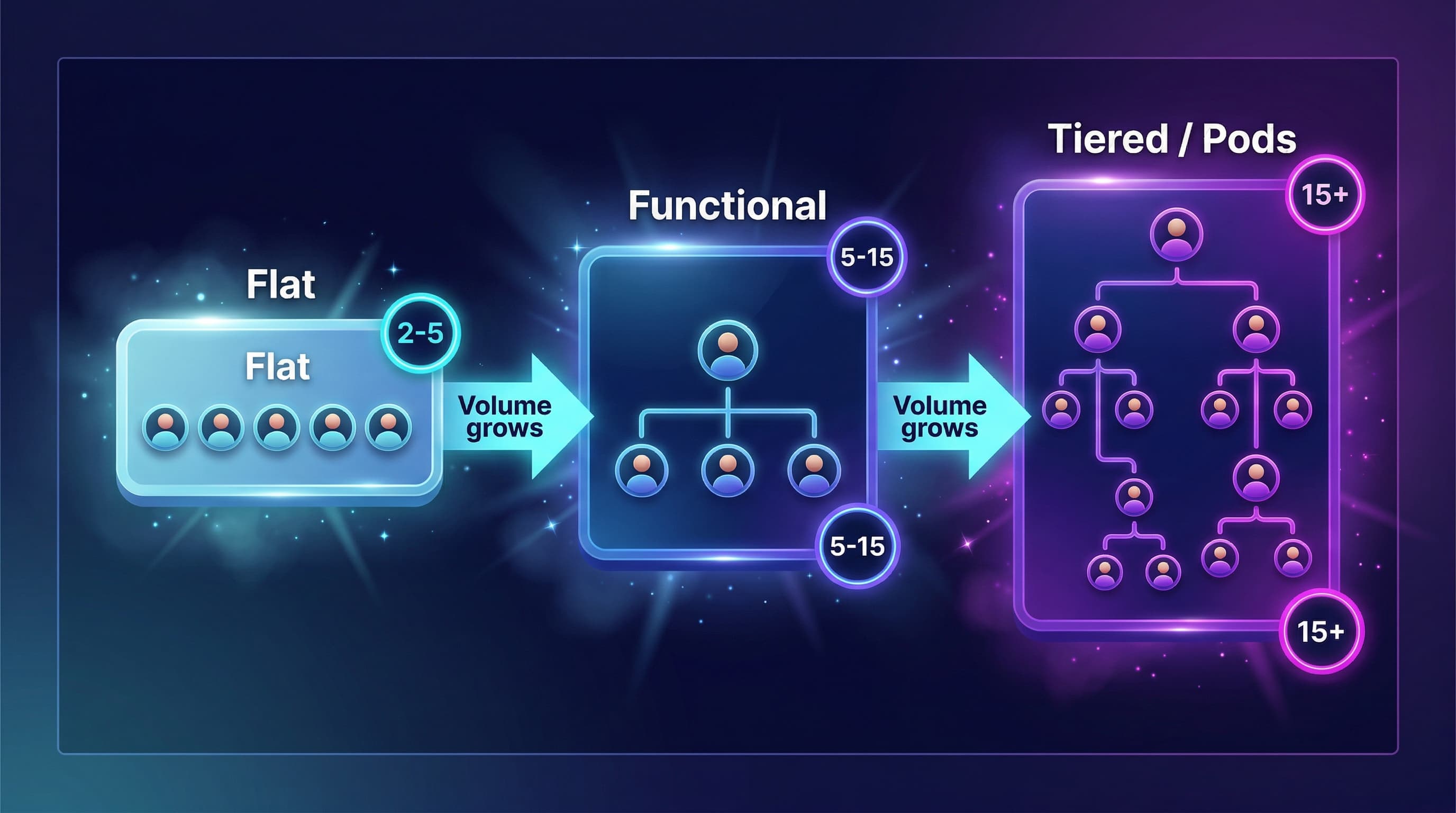
Structure should follow ticket volume, channel complexity, and product technicality. A DeFi protocol with a highly technical user base needs a very different setup than a B2C app with a broad consumer audience. Here's how the models compare:
|
Model |
Team Size Fit |
Pros |
Cons |
When to Switch |
|---|---|---|---|---|
|
Flat |
2-5 people |
Fast decisions, no hierarchy friction |
Breaks down as volume grows |
When ticket volume exceeds one person's scope |
|
Functional (Lead + Reps) |
5-15 people |
Clear ownership, mentorship path |
Can silo if not cross-trained |
When you hit 200-500 weekly tickets |
|
Tiered/Matrix (Pods) |
15+ people |
Scales across channels and specializations |
Coordination overhead |
When channels or product complexity multiplies |
Start with two roles: a support representative and a support lead. The rep handles day-to-day inquiries and keeps response times in check. The lead owns the process, identifies patterns, escalates where needed, and builds the foundation of your internal playbook.
These two roles can carry significant volume with the right tools and workflows. Both need to be genuinely community-fluent, not just technically capable. In community-driven startups, your support team often becomes the face of the brand in the spaces where users spend most of their time.
At 200-500 weekly tickets, you move to a functional model: two to three reps under a lead, with clear ownership by channel or query type. Beyond 500 tickets per week, cross-functional pods that span channels and specializations make more sense. The structure should always follow the data.
If you're building a support team for a community-first product, a polished resume matters less than you'd expect. Someone with enterprise call center experience may be technically qualified but completely unprepared for the informal, fast-paced dynamics of a Discord server or Telegram community.
Prioritize three things:
Skip the generic trait lists. Evaluate via scenario-based simulations instead. Give candidates a mock Slack or Discord thread with a frustrated user and watch how they respond. That exercise surfaces more useful signal than any interview question.
Your first support lead is the most consequential hire in the entire build-out. This person won't just handle tickets. They'll build the process, shape the tone, and set expectations for every future hire.
Look for someone with 2+ years of experience in community tools and at least one early-stage build-out in their background. Evaluate them through live simulations in mock Slack or Discord threads. A track record of scaling from a small base is far more relevant than experience managing a large, established department.

One of the stranger challenges here is that you often need to onboard people before you've documented anything. The goal isn't to hand someone a complete manual. It's to give them enough context, confidence, and tool access to start contributing quickly while helping you build the documentation future hires will rely on.
Week 1: Channel immersion. New hires shadow the founder in live Discord, Telegram, and Slack environments, mapping the most common query types: onboarding flows, token issues, wallet connection errors, access problems. No solo handling yet, just observation and pattern recognition.
Week 2: Role-plays for de-escalation in simulated threads. Introduce feedback loops to the product team for recurring issues that signal product gaps. Grant hands-on server access and move to handling routine inquiries independently, with clear escalation paths for anything outside their scope.
Community channels each have their own norms. Discord is fast and casual. Telegram ranges from technical deep dives to rapid-fire noise. Slack tends to sit somewhere in between. A rigid, corporate tone feels out of place in all three.
Build a tone framework that fits your brand's personality across each platform. Define what language feels on-brand, what level of formality suits different inquiry types, and which topics warrant a move to a private support channel. Template responses for common questions save time, but give the team room to personalize within the framework.

Without documented processes, knowledge lives in people's heads. That's manageable at one person but becomes a real liability the moment that person leaves or you need to onboard someone fast.
These are the operational targets to build your processes around:
Escalation procedures define who handles what and at what threshold, reducing resolution time and preventing agents from getting stuck on issues that need a different access level. A basic internal knowledge base pays dividends fast: when agents can search for answers rather than reinvent them, resolution speed and consistency both improve.
Define these clearly for a team that may not have a support background:
Track community sentiment too (reactions, mentions, tone in public channels) alongside a feedback-to-feature capture ratio that logs recurring issues into the product roadmap. Track these consistently and they'll drive staffing decisions, training priorities, and tooling investments far more reliably than a dashboard full of vanity metrics.
For a team operating across Discord, Telegram, Slack, and web chat, the biggest practical challenge is fragmentation. When conversations are scattered across platforms, agents lose context, tickets get missed, and response times suffer. A unified inbox that pulls all those channels into one view solves that problem directly.
That's what Mava is built for. It's an AI-first customer support platform purpose-built for community-driven companies, not a generic helpdesk retrofitted for Discord. It connects to Discord customer support, Telegram support, Slack, web chat, and email, routing everything into one shared inbox. Setup takes around 20 minutes. Pricing is flat-rate with unlimited seats and AI included, which makes it practical for fast-growing teams that need flexibility without a ballooning per-seat cost.
Mava's AI-first approach automatically resolves up to 50% of common queries, handling FAQs, onboarding steps, and repetitive requests before they reach a human agent. That deflection is what lets a small team handle volume that would otherwise require several more hires. Mava supports 3,000+ communities and has handled 3.5M+ support tickets for clients including TikTok, EigenLayer, Layer3, and Alchemy.
Start free and have your support function running the same day.

The most effective early-stage support teams don't just respond to volume. They actively reduce it through smart tooling and self-service design. Every ticket deflected by AI or resolved through a public FAQ is a ticket your team doesn't handle manually.
At 200+ tickets per week, layering in AI automation targeting roughly up to 50% FAQ deflection is how small teams stay ahead of volume without linear headcount growth. Communities operating at scale with lean support functions use this model: AI handles wallet connection issues, onboarding questions, and token transfer FAQs, freeing human agents entirely for escalations and high-stakes conversations.
Mava's shared inbox and built-in analytics surface CSAT scores, AI-resolved vs. human-resolved ticket ratios, response times, and the most commonly asked questions, making measurement accessible from day one without a dedicated analytics function.
Automation handles the highest-volume, lowest-complexity inquiries. Self-service extends that logic further. A well-maintained knowledge base, a searchable FAQ section, and active community forums where experienced users help newer ones can meaningfully reduce inbound volume without reducing experience quality.
You don't need a large team to deliver great support. You need the right people, the right structure, and tools that multiply their capacity.
How many customer support agents do we need as a startup? Most early-stage teams can manage initial volume with one support rep and one support lead, provided they have solid tooling and AI handling repetitive queries. Let ticket volume and response time data drive the next hire rather than arbitrary headcount targets.
What's the average response time benchmark for early-stage startups? Expectations vary by channel. For live chat, under 1-2 minutes is the target; for email, under 4 hours is the SMB standard; for community platforms like Discord and Telegram, treat them like social media and aim for under 60 minutes. Small teams can hit these benchmarks by pairing AI deflection with a centralized inbox.
Should we hire a support person or use AI first? Both at the same time rather than in sequence. AI handles repetitive, high-volume queries from day one, freeing the first hire to focus on complex issues and relationship-building. Hiring without tooling leads to burnout. Deploying AI without a human owner leads to poor-quality responses that damage trust.
.png)
.png)
.png)
