.png) Get Started
Get Started
Support teams usually don't choose between WhatsApp and Telegram when the community is small. The choice shows up later, when a chat that once felt manageable turns into a queue, a moderation problem, and a customer experience risk all at once.
A startup launches with a founder-led WhatsApp group. It works for onboarding, quick answers, and building trust. Then product updates create repeated questions, power users start answering newer members, spam slips in, and nobody can tell which issues were resolved versus ignored. Another company starts on Telegram because it wants reach and openness. That works too, until the public group turns into a mix of support, announcements, speculation, scams, and side conversations that bury real tickets.
That's the key decision point with WhatsApp and Telegram. This isn't just a feature comparison. It's a commitment to a support model, a moderation model, and a workflow your team will live inside every day.
A team usually notices the problem in operations first, not strategy. Response times get uneven. Moderators answer the same question repeatedly. Product bugs disappear into chat history. VIP customers expect direct help, while newer users need a place to ask simple questions without getting lost.
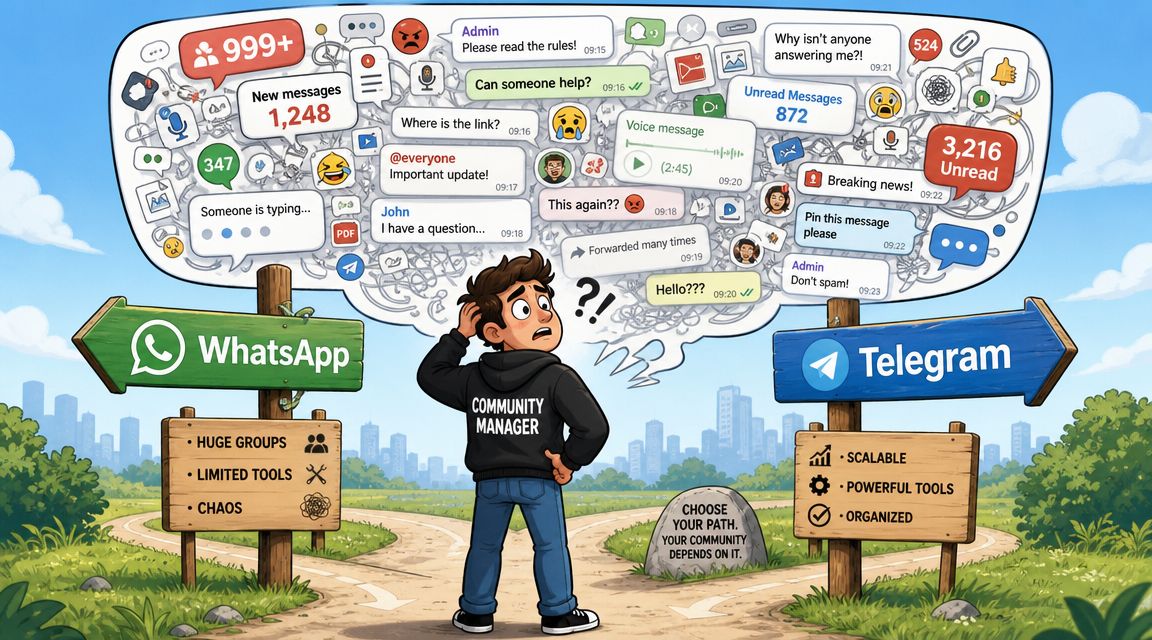
At that point, the platform starts shaping the support team more than the support team shapes the platform. WhatsApp pulls teams toward intimate, reply-heavy conversations. Telegram pulls them toward broader, more layered spaces that combine broadcast, discussion, and automation.
The scale of both platforms is a big part of why this choice matters. WhatsApp is the world's largest messaging app by reach, with 3 billion monthly users as of October 2025, while Telegram crossed 1 billion monthly active users in March 2025 according to the referenced reporting and market summary in Statista's global messenger ranking. In practice, that means neither choice is niche. Both are mainstream enough to become a company's front line.
The visible question is which app members prefer. The harder question is what kind of operation the team can sustain.
Practical rule: If the team can't explain how it will triage, escalate, and moderate messages after growth, the platform choice hasn't been made yet.
The wrong decision usually doesn't fail on day one. It fails when message volume rises and the team realizes the app's default behavior is now running the support function.
WhatsApp and Telegram look similar on the surface. Both are messaging apps. Both support groups. Both can become customer touchpoints. Operationally, they come from different assumptions.
WhatsApp feels like a messaging utility that businesses have adapted for support. Telegram feels like a communication platform that communities have adapted for support. That distinction matters because users arrive with different expectations before the first moderator even replies.
Users generally treat WhatsApp as personal space. They use it with family, close contacts, small groups, and direct service conversations. That creates a different support dynamic. When a customer sends a message there, the expectation often isn't “join the crowd.” It's “help me directly.”
That can be a strength. For high-touch support, account issues, onboarding help, and relationship-heavy customer success, that expectation works in your favor. The thread feels immediate and familiar.
It also creates pressure.
Telegram users are usually more comfortable with channels, large groups, bots, and semi-public participation. They expect discovery, announcements, role-based moderation, and message flows that don't depend on one human answering every question in order.
That changes how support behaves. Teams can separate broadcast from discussion, let communities self-organize, and deploy bots without the same friction. For product communities, creator ecosystems, trading groups, gaming audiences, and global user bases, that design is often a better cultural fit.
A 2026 industry summary reported that Telegram crossed 1 billion monthly active users in March 2025, up from about 800 million in 2023, and noted that India accounts for more than 20% of its user base, with popularity in markets such as Iran and Uzbekistan, according to this Telegram statistics summary. Those details matter because support teams don't just choose tools. They choose where their users already know how to behave.
User expectation is part of the product. A support operation runs more smoothly when the platform's social norms already match the team's workflow.
A company can force support into either app, but it will spend more effort fighting defaults.
WhatsApp works better when the business wants closeness, familiarity, and controlled service threads. Telegram works better when the business needs scale, visibility, and community mechanics built into daily operations. That's why the right choice usually starts with user behavior, not a checklist of features.
A support lead usually feels the platform choice when the member count rises and the message mix gets messy. Announcements, repeat questions, peer replies, moderation actions, and escalations all start competing in the same feed. At that point, group design stops being a product preference and becomes an operating constraint.
FeatureWhatsAppTelegramGroup sizeUp to 1,024 members according to this comparison of Telegram and WhatsApp limitsSupergroups up to 200,000 membersBroadcast formatGroup-centric and smaller-scaleChannels with unlimited subscribersBest fitSmaller, tighter support groupsLarge public communities and broadcast-led ecosystemsOperational styleConversation-firstLayered broadcast plus discussion
Those limits shape staffing, moderation, and response quality.
WhatsApp works best when one shared thread is the point. That fits onboarding cohorts, regional customer circles, paid communities, or high-touch programs where members expect direct access and the team wants tighter control over who speaks with whom. The format is familiar, which lowers adoption friction, but it also pushes very different jobs into one place once the group grows.
That is where support teams start paying for simplicity. The same thread ends up carrying service questions, product feedback, status updates, duplicate bug reports, and side conversations. Moderators spend more time redirecting people and repeating answers. Agents lose context because important issues are buried under chatter.
Telegram gives teams more ways to separate those jobs before the volume becomes a staffing problem. A company can publish updates in a channel, keep discussion in a linked group, and add bots or routing rules around both. That structure is not just cleaner for members. It reduces moderator load and makes escalation paths easier to maintain.
Teams building around channels usually need workflows, not just posting rights. This guide to a Telegram channels bot workflow shows how channel operations start connecting to automation once support becomes recurring and multi-admin.
A support channel fails slowly. First response times slip, then moderation gets inconsistent, then valuable members stop asking because the space feels noisy.
WhatsApp breaks down when the team needs one environment to serve as a help desk, announcement stream, and member community at the same time. It can still work, but only with tighter manual management and lower tolerance for scale.
Telegram breaks down in a different way. It gives operators more structural control, but that control needs clear rules. Without channel governance, admin roles, bot logic, and escalation ownership, a large Telegram setup can become fragmented across too many spaces.
Choose based on operating model.
For a growing company, this is the core question: can the team separate broadcasting, triage, peer support, and admin control in a way staff can sustain every day? That answer usually decides the platform faster than any feature checklist.
Most platform comparisons stop at encryption. That's too shallow for a support team.
A company running community support isn't only responsible for message content. It's also responsible for member exposure, contact handling, profile visibility, and how easily bad actors can map the people inside the community.

WhatsApp is widely understood as the more straightforward choice for default private messaging expectations. Telegram is more complicated because not every interaction is designed the same way, and teams often overestimate what “secure messenger” means in a public or semi-public community context.
That alone should make operators cautious. Support teams frequently discuss security in terms of message content, while the daily risk sits elsewhere. Member identity, availability, profile data, and phone-number-based discovery can all become attack surfaces.
Research highlighted in this report on contact discovery and profile metadata exposure found that both WhatsApp and Telegram were vulnerable to crawling attacks that can collect profile pictures, nicknames, status texts, and last-online times at scale. The same reporting notes that for Telegram, this exposure can affect even phone numbers not registered on the service.
Privacy risk in community support usually shows up in three places:
A more grounded security review should also include public-group behavior, admin permissions, backup practices, and how moderators handle member data outside the app. Teams looking closely at Telegram-specific concerns may want this practical breakdown of Telegram chat safety and security trade-offs.
Security decisions for support teams should start with exposure mapping, not marketing language.
If a support function handles sensitive cases, the platform should be chosen with metadata and discovery risk in mind, not just encryption labels. For broad public communities, the question isn't “Which app sounds safer?” It's “What information can attackers infer even when messages themselves stay protected?”
That's the question teams ask too late.
Automation is where the operational gap gets very real. Once support volume rises, teams need routing, tagging, auto-replies, escalation logic, and ways to connect conversations with other systems.
Telegram and WhatsApp support that goal very differently.

Telegram exposes a public Bot API and allows file transfers up to 2 GB, which makes it more suitable for custom, high-volume workflows, according to this comparison of Telegram and WhatsApp automation models. That matters when support isn't just about answering text questions.
A gaming studio may need users to submit logs or videos. A developer tools company may want a bot to classify issues and route them by product area. A web3 project may need moderation actions, FAQ responses, and channel-specific workflows running together. Telegram is better suited to that kind of buildable environment.
WhatsApp's business automation typically runs through its official Business API, with a more controlled approval and template model. For some teams, that's a feature, not a bug. It pushes support toward a cleaner inbox pattern and more predictable business messaging rules.
That makes WhatsApp useful when the team wants consistency over experimentation. Customer service flows, appointment confirmations, account help, and transactional support often benefit from those constraints. The downside is reduced flexibility for teams that want to customize heavily or move fast with bespoke automations.
The difference can be framed as follows:
A concrete example helps. This walkthrough of a Telegram AI chatbot setup shows the kind of automation layer teams often add once moderators can't manually answer every repeated question.
For a visual explanation of how messaging automation starts to change support work, this short video is useful:
The right API matters less than the right operating model. Automation should remove repetitive work, not make the support stack harder to manage.
This is also where third-party tooling enters the picture. If the company already relies on helpdesk workflows, knowledge bases, or AI-assisted triage, the messaging platform has to fit that stack. Telegram usually offers more freedom. WhatsApp usually offers more guardrails. Teams should decide which friction they'd rather live with.
A platform can look affordable until moderation starts consuming staff time. That's the hidden budget line many teams miss.
Telegram generally gives operators more room to manage public, high-volume spaces. Its broader bot ecosystem and community-oriented structure make it easier to support workflows like filtering, routing, anti-spam actions, and layered communication. That matters because moderation isn't only about removing bad content. It's about keeping legitimate support visible.
WhatsApp can work well for smaller support environments, but it becomes labor-heavy if the team tries to run open-ended community support there. Messages pile up in the same interaction layer where support should feel personal. Repetitive questions crowd out urgent ones. Admins spend time manually redirecting members instead of resolving issues.
Telegram creates different costs. Openness attracts more noise, more edge cases, and stronger trust-and-safety requirements. Public-facing groups also need clearer rules, escalation paths, and moderator coverage because misuse can happen in view of the whole community.
Investigative reporting summarized in this account of scam activity moving from public groups into private chats shows why this matters. Public WhatsApp groups were used to recruit targets before conversations moved into private messaging on WhatsApp, Telegram, or Facebook to intensify pressure. That pattern applies beyond one app. The operational lesson is that support teams managing community spaces are also managing abuse pathways.
A practical cost review should include:
Cheap software can still produce an expensive operation if every exception lands on a human.
For tighter support use cases, WhatsApp can justify its constraints because the interaction quality is high and the environment is narrower. For bigger community ecosystems, Telegram often wins on total operational manageability because it gives teams more ways to shape traffic before it overwhelms moderators.
The right comparison isn't “Which app is free?” It's “Which app lets the team hold service quality as volume and complexity grow?”
A support lead usually feels this decision when volume starts breaking the old setup. Response times slip. Moderators answer the same question in three places. Customers keep using the channel they prefer, whether the team has built for it or not.
Choose WhatsApp if support is primarily one-to-one, high-context, and tied to service resolution. It works well for account issues, local service operations, customer success follow-up, and any workflow where a private thread matters more than community visibility.
Choose Telegram if the team needs broader distribution, layered communities, stronger admin controls, and more room to automate. It is often a better fit for product communities, trading or gaming groups, creator audiences, and support programs where members help each other before staff step in.
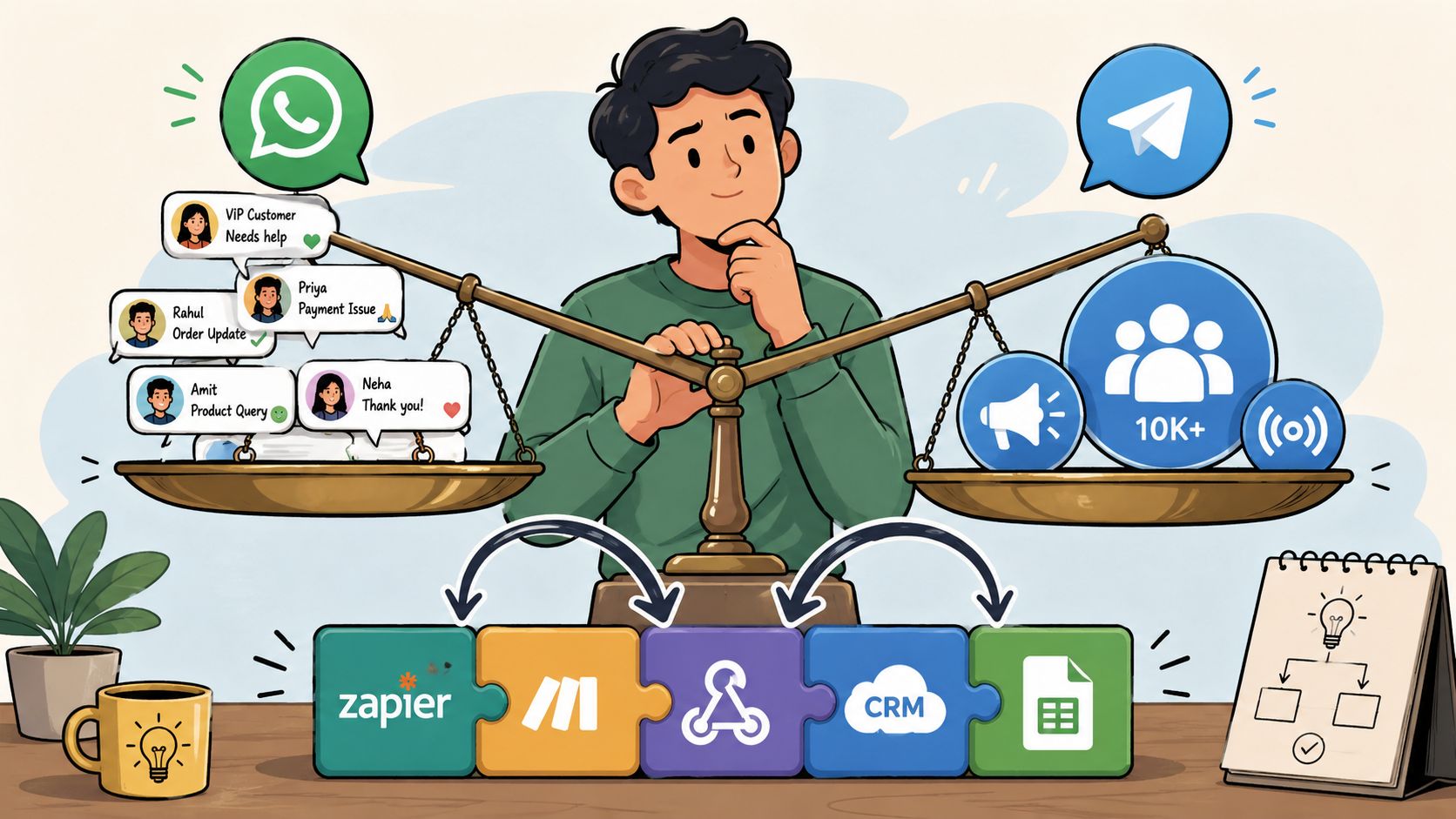
The app does not solve routing, ownership, reporting, or handoffs. Those problems show up as soon as support spreads across chat, community, and web channels.
Teams that scale this well usually add a shared support layer early. Tools such as Mava connect channels like Telegram and web chat into one queue so agents can assign conversations, track status, use AI for repetitive questions, and stop relying on copy-paste workflows between moderators and support staff.
A practical decision framework:
The same operating principle shows up outside software. Planning group experiences through Food Escapes Manchester depends on coordination, pacing, and clear ownership once participation grows. Community support works the same way.
The better choice is the one your team can run consistently under pressure. The better setup combines the right channel with systems that keep service quality intact as volume grows.
If support is spreading across Telegram, web chat, and other community channels, Mava gives teams one shared inbox, AI-assisted replies, and structured workflows so conversations don't disappear into chat.
.png)
.png)
.png)
