.png) Get Started
Get Started
Wick, Beemo, Security Bot, Dyno, and other anti-raid bots each defend against join floods and coordinated spam differently, with tradeoffs in setup complexity and detection depth. This guide compares the top 10 anti-raid bots for 2026 to help you pick proactive protection before an attack hits.
A Discord server usually feels healthy right before it gets tested. New members are arriving, conversation is moving, and moderation still seems manageable. Then the pattern changes. A cluster of fresh accounts joins at once, the same message appears across channels, and moderators start playing catch-up instead of controlling the space.
That's the moment when manual moderation stops being enough. Discord grew from 56 million monthly active users in 2019 to 150 million in 2021, a shift that helps explain why anti-raid bots became a core moderation category as communities scaled and attacks got faster according to Cakey Bot's anti-raid documentation. A mature anti-raid bot Discord setup now means more than deleting spam. It means automated join-rate checks, account-age filters, duplicate-message detection, verification gates, and lockdown actions that trigger before a server gets overrun.
The market is crowded, but the tools don't all solve the same problem. Some are heavy-duty security suites. Some are verification gates built to stop alt waves at the door. Others are fast-response tools that help moderators contain damage during a live incident.
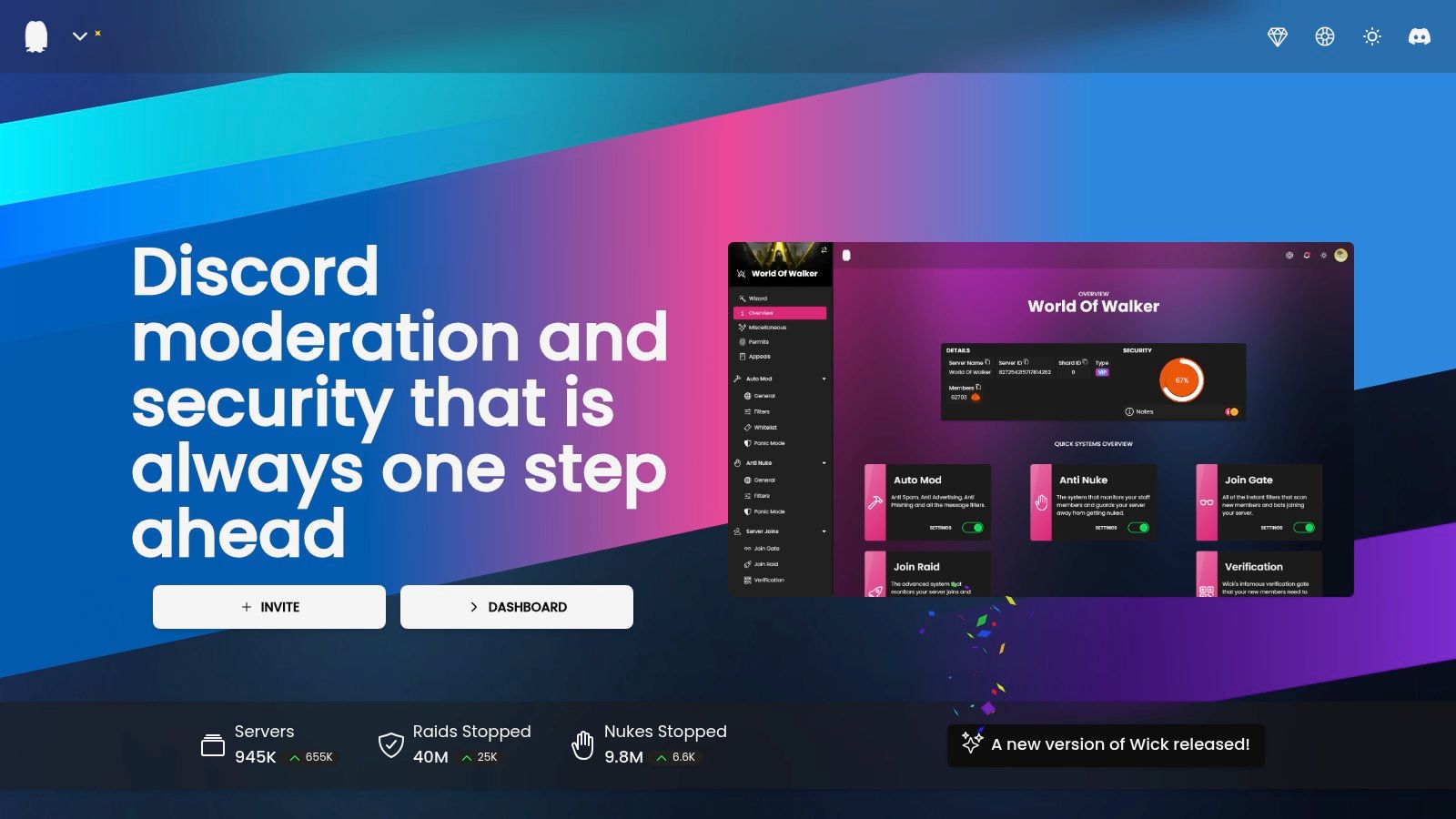
Wick fits servers that need layered security, not just spam cleanup. It's usually the right choice when admins worry about raids and permission abuse at the same time, especially in communities where too many staff roles, webhook access, or risky integrations can turn a normal moderation problem into a server-wide incident.
Its value is depth. Wick combines anti-raid controls with anti-nuke protection, verification, and incident response. That matters because many raids aren't only message floods. Some attacks target channels, roles, and permissions after one compromised account gets increased access.
Wick makes sense for gaming servers, creator hubs, and larger public communities that need rules around who can do what, and what the bot should punish automatically.
For teams comparing anti-raid and anti-nuke coverage together, this breakdown of Discord anti-nuke bot options gives useful context.
Practical rule: Wick is better when moderators want policy control. It's worse when they want a bot they can install and ignore.
The free core is useful, but some advanced capabilities sit behind paid plans. That's common in this category. The practical question isn't whether premium exists. It's whether the free tier already covers the failure mode the server is most likely to face.
Website: Wick
Beemo takes the opposite approach. It's built for admins who don't want a dense dashboard and don't want to tune detection thresholds every week. In the anti raid bot Discord category, that simplicity is a real advantage for smaller teams.
A lot of communities don't fail because they lack features. They fail because nobody maintains the features they already installed. Beemo's pitch is straightforward. Keep anti-raid protection running in the background and intervene automatically when a raid pattern appears.
This is the right shape of tool for servers with limited moderator time, especially gaming communities and fast-moving public servers where the team wants immediate baseline protection without turning setup into a project.
That trade-off is important. Minimalist bots often reduce admin burden, but they can frustrate power users who want custom thresholds, custom verification rules, or detailed enforcement logic. If a server is still early in its growth and the biggest concern is bot waves rather than staff abuse or channel destruction, Beemo can be a clean first layer.
Some broader moderation tools are tied to paid tiers, so it's best treated as a focused anti-raid option rather than a complete moderation operating system.
Website: Beemo

FirewallX is for admins who want security rules to be explicit. Some bots feel opaque. They act, but the team isn't always sure why. FirewallX leans into predictable controls, layered automation, and recovery options such as snapshots and restore.
That recovery piece matters more than many server owners expect. Raid prevention is the priority, but prevention isn't perfect. If a compromised moderator or malicious integration changes channels, roles, or permissions, a restore path can save hours of cleanup.
FirewallX is strongest when a community wants a rule-based engine and post-incident recovery in the same tool.
Recovery features don't stop a raid. They reduce the cost of the raid that gets through.
This kind of tool is usually a good fit for established servers that already know their threat profile. If admins can define what counts as suspicious role changes, dangerous permission edits, or abnormal join spikes, FirewallX gives them a clean framework to automate against those patterns.
Website: FirewallX
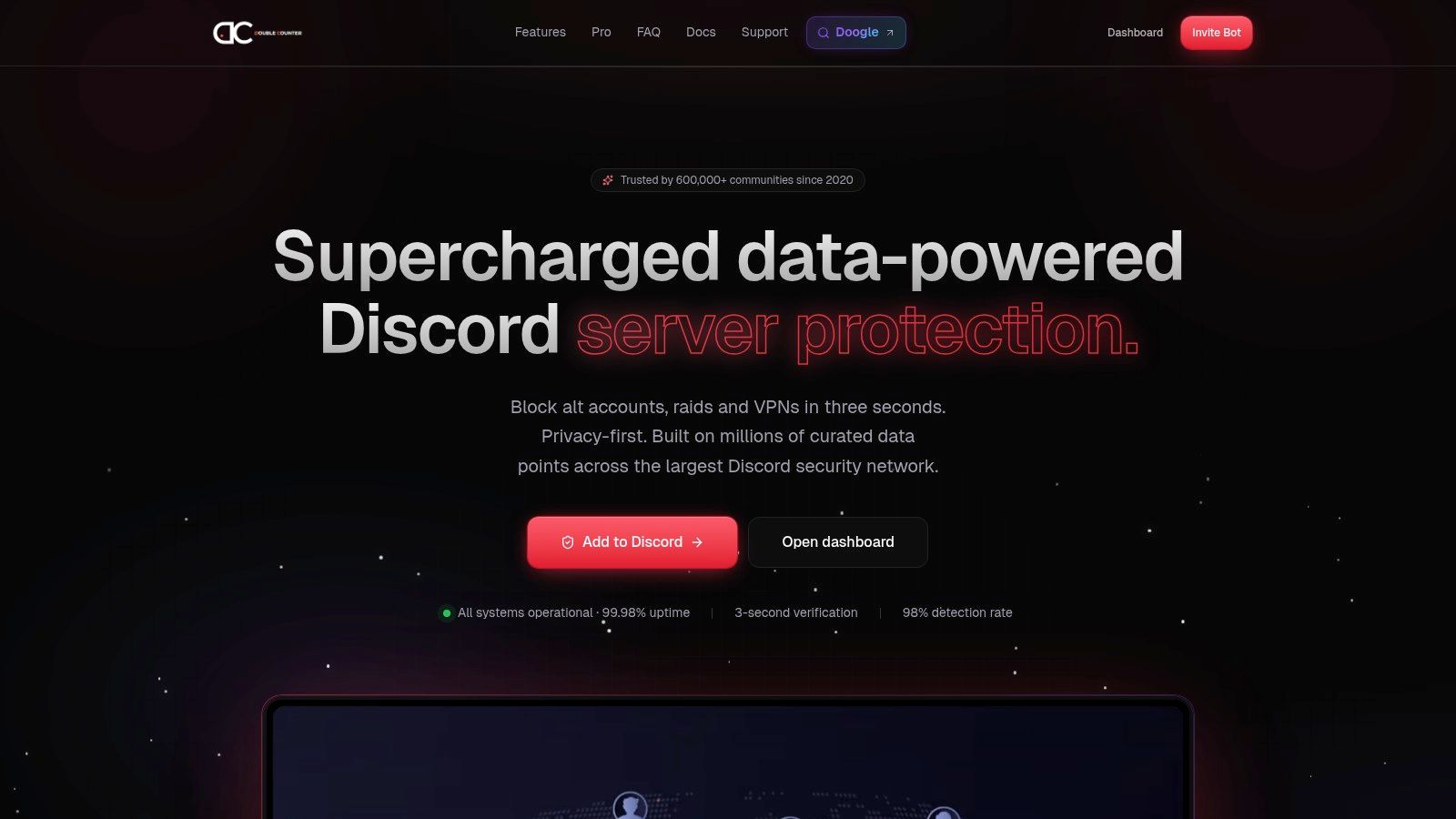
Double Counter belongs in a different bucket from classic anti-spam bots. It's a verification gate first. That makes it valuable for communities dealing with alt accounts, ban evasion, VPN use, and repeat join attempts from low-trust traffic.
Its strongest use case is not “clean up spam after it lands.” It's “make suspicious users prove they're legitimate before they ever reach the main server.” For communities that get targeted repeatedly, that shift from reaction to screening can change moderator workload completely.
Verification systems always create friction. The benefit is obvious during attacks. The downside appears on normal days, when real users have to complete one more step before joining the conversation.
Public guidance often recommends member screening, minimum account age, CAPTCHA-style verification, and then active anti-raid monitoring as a layered defense, as outlined in CommunityOne's security guide. Double Counter fits directly into that model.
For servers in crypto, trading, giveaways, or controversial fandoms, that trade is often worth it. For private friend groups or low-friction hobby communities, it may be too much.
Website: Double Counter
Captcha.bot solves a narrower but common problem. A server doesn't need advanced policy logic. It needs to stop bot raids at the join gate and cut down scam links inside the server. For that, verification-first tools still hold up well.
This category exists because anti-raid protection isn't only about detection after entry. Some of the best damage reduction happens before a user gets access to any visible channel. Captcha and role-gate flows are blunt compared with more adaptive systems, but they remain effective when the threat is large-volume automated joins.
Captcha.bot is a practical fit for large public communities, support servers, and creator servers that get a mix of genuine newcomers and low-quality traffic.
It also fits Discord's broader security direction. Discord remains a large operational surface, with independent summaries estimating 231 million monthly active users globally in early 2025, more than 30 million servers, and over 1.1 billion messages sent, which helps explain why anti-raid tooling has to work at high volume in SQ Magazine's Discord statistics roundup.
For teams setting up the funnel itself, this guide on how to make a verify channel in Discord is a useful companion.
That last point is the one admins often underestimate. Verification works, but every extra step can reduce onboarding momentum.
Website: Captcha.bot
Security Bot sits in the all-in-one camp. It combines anti-raid, anti-nuke, anti-spam, verification, and logging in a single package. That's attractive for teams that want one security layer instead of stitching together separate bots and trying to manage overlap.
The upside of an all-in-one bot is obvious. Fewer moving parts, fewer permission conflicts, and one place to review what happened during an incident. The downside is also obvious. The more a bot can do, the more time a team has to spend deciding how it should behave.
Security Bot is a strong fit for medium to large public servers where admins want both active protection and verification workflows, but don't want a fragmented stack.
As a category, anti-raid products have clearly moved beyond niche utility. AntiRaid says it is trusted by 3,942,017+ users, a useful signal that dedicated anti-raid tooling has become mainstream Discord infrastructure rather than a specialist add-on on the AntiRaid website.
Operational takeaway: All-in-one tools help most when the moderation team actually commits to configuration reviews. If nobody revisits the settings, breadth turns into clutter.
For teams evaluating this kind of stack, this overview of a Discord security bot setup helps frame the implementation work.
Website: Security Bot

Sledgehammer is less about polished onboarding and more about fast incident response. That makes it useful for moderator teams that already know what they're looking at during a raid and need commands that let them act immediately.
Some servers don't need another full moderation suite. They need a tool that helps staff mass-ban a raid wave, coordinate across multiple communities, and apply pressure quickly before the attack spreads.
Sledgehammer's anti-bot and raidban-style tooling can be effective in active incidents, particularly for experienced moderators who want lightweight commands instead of another dashboard.
Availability can also matter. If a bot's platform status or distribution changes, that affects whether it can be relied on as a permanent foundation. That's why response-focused tools like Sledgehammer often work best alongside a prevention layer that screens joins before human moderators need to step in.
Website: Sledgehammer
TrenchWorm is another verification-first option, but it leans more into policy control than a simple CAPTCHA gate. OAuth-based verification, account-age rules, join-age checks, and quarantine logic make it a good fit for communities that want to control access based on trust signals and role assignment.
That policy layer can be useful in communities where not every member should move through the same onboarding path. A support server, gated alpha community, or private project hub might want different verification outcomes depending on user status or risk level.
TrenchWorm is strongest when verification is part of the community design, not just an emergency brake.
The practical caution is adoption burden. A smaller ecosystem usually means less community documentation, fewer examples from other admins, and less troubleshooting content when something breaks. For experienced operators, that's manageable. For volunteer teams, it can slow rollout.
Website: TrenchWorm

Zeppelin is a moderation platform first and a raid-mitigation option second. That distinction matters. It isn't the first recommendation for a server that expects direct raid pressure tomorrow, but it can be an excellent policy engine for communities that value control, overrides, logging, and self-hosting.
Its appeal is reliability and transparency. Open-source availability and self-hosting options give technical teams more confidence about how the tool works and how it fits into an existing moderation stack.
Zeppelin works best for communities with administrators who want to write moderation policy carefully and maintain it over time.
Self-hosting gives control, but it also creates operational responsibility. Someone has to maintain infrastructure, permissions, and uptime.
That trade is easy to underestimate. Hosted bots shift operational burden to the vendor. Self-hosted tools shift it back to the community. For technically mature teams, that's acceptable. For most fast-growing public servers, it's often more burden than benefit.
Website: Zeppelin
Dyno is the familiar generalist on this list. It's widely recognized as a moderation bot with automod, dashboards, and mass-action tools. It isn't a specialized anti raid bot Discord operators would choose for advanced raid defense alone, but it still has a place because many teams already know how to use it.
Familiarity matters during incidents. A bot with less specialized detection but a workflow the moderation team understands can outperform a stronger product that nobody configured properly. Dyno's automod, slowmode, and mass moderation utilities can still help contain spam waves and clean up after bad joins.
Dyno is a reasonable choice when a team wants broad moderation coverage and only moderate anti-raid support, or when it needs a secondary operational tool alongside a more specialized security bot.
This is also where market context matters. Discord remains heavily community-led, while formal enterprise adoption is limited. Ramp reports that as of May 2026, fewer than 1% of organizations with a vendor in the Communication category use Discord in its Discord vendor profile. That's a useful reminder that anti-raid buying decisions are usually made by community operators, not enterprise procurement teams. Practical outcomes matter more than polished IT checklists.
Website: Dyno
| Bot | Core capabilities | Ease of setup & UX | Best for (target audience) | Unique selling point | Price / notable limits |
|---|---|---|---|---|---|
| Wick | Anti‑Nuke, Anti‑Raid, verification, miniWick helper | Feature‑rich; steeper learning curve | Very large, battle‑tested communities | Granular security controls without heavy scripting | Free core; premium add‑ons for advanced tools |
| Beemo | Always‑on anti‑raid auto‑ban, conservative logging | Minimal setup; set‑and‑forget UX | Gaming servers & low‑touch communities | Auto‑ban algorithm tuned for raid waves | Free anti‑raid; Beemo Max adds broader features |
| FirewallX | Rule‑based anti‑raid/nuke/spam, snapshots & restore | Requires initial config; predictable rules | Servers prioritizing predictable policies & recovery | One‑click structure snapshots and instant restore | Some premium features behind paid tiers |
| Double Counter | Fast 3s verification, device/IP scoring, quarantine | Fast verification; third‑party privacy considerations | Very large servers facing alts/ban‑evaders | Large network dataset for high‑accuracy scoring | Privacy/usability concerns for some communities |
| Captcha.bot | Captcha/role‑gate verification, anti‑phishing, link filtering | External verification flow; needs user communication | Communities needing strong join‑time vetting & phishing defense | Built‑in phishing & scam domain filtering | Mature workflow; external flow may affect UX |
| Security Bot | Anti‑Raid, Anti‑Nuke, Anti‑Spam, recovery, “Beast Mode” | Many options → higher setup time; active dev | Teams wanting an all‑in‑one, actively maintained solution | Incident “Beast Mode” and recovery workflows | Core features free; some branding/custom add‑ons paid |
| Sledgehammer | Anti‑bot, raidban mass‑ban, global ban tools | Lightweight; practical for fast actions | Moderation teams needing rapid incident response | Fast mass‑ban/raidban commands for live raids | Free; availability may vary (whitelisting reports) |
| TrenchWorm | OAuth verification, IP collision checks, quarantine | Modern onboarding; smaller ecosystem | Servers wanting policy gates and role assignment | OAuth‑based verification with policy‑driven roles | Core free; premium features planned |
| Zeppelin | Extensive Automod, granular overrides, self‑host option | Reliability focused; self‑hosting requires infra | Large servers seeking policy‑driven moderation & control | Open‑source / self‑hosting for max control | Self‑host needs maintenance; public invites may be restricted |
| Dyno | Automod, mass actions, web dashboard, modular config | Familiar UI; well‑documented | Moderation teams wanting a known, modular tool | Large user base and proven moderation workflows | Not specialized anti‑raid; may need layered defenses |
A raid rarely starts with the dramatic part. It starts with a few suspicious joins at 2 a.m., a burst of throwaway accounts, or one compromised moderator account with more permissions than it should have. By the time channels are wiped or pings are flying, the important decisions were already made in the setup.
The practical question is not which bot has the longest feature list. It is which failure mode would hurt this server first.
Use that lens to choose a category before you choose a bot. Heavy-duty suites such as Wick, FirewallX, and Security Bot fit large public servers, creator communities, and support servers that face several risks at once. They take more time to configure, and they can be noisy if roles and permissions are sloppy, but they give staff real control when raids, spam, and destructive actions overlap.
Specialized defenders such as Beemo and Sledgehammer fit teams that want a narrower job done well. Beemo makes sense as a low-maintenance baseline for smaller communities that need steady anti-spam and anti-raid coverage without a long setup project. Sledgehammer is more operational. It suits moderator teams that expect live incidents and want fast mass-action tools when timing matters.
Verification gates such as Double Counter, Captcha.bot, and TrenchWorm solve a different problem. They filter bad traffic before it becomes a moderation queue. That is often the right answer for gaming servers, giveaway-heavy communities, and any server dealing with alt waves or ban evasion. The trade-off is member friction. Every extra verification step removes some legitimate users along with the attackers, a point reflected in DiscordList's bot page discussion of verification-heavy anti-raid setups](https://discordlist.gg/bot/651095740390834176).
Zeppelin and Dyno belong in the decision framework too, even if they are not pure anti-raid picks. Zeppelin fits teams that want policy control and may prefer self-hosting. Dyno fits teams that already know its moderation workflow and want to pair it with a more focused security layer.
Layering matters, but stacking tools carelessly causes its own problems. I have seen servers run multiple bots with overlapping punishments, conflicting role logic, and no clear incident owner. The cleaner model is usually one join gate, one primary enforcement bot, and one response playbook the staff can follow under pressure.
Blocking the raid is only part of the job. Members still ask what happened, appeal mistakes, or need help after channels lock down. Teams handling support across Discord and other channels may also use Mava for ticketing and shared inbox workflows alongside their moderation stack.
.png)
.png)
.png)
