.png) Get Started
Get Started
Community managers see this pattern every week. A Telegram channel in the same niche posts a product update, a market take, or a meme thread, and the comments light up fast. The audience is clearly there, already organized by interest, and far more intentional than a cold social feed audience.
The frustration is that Telegram still doesn't feel like a normal ad network. There isn't a single obvious playbook for reaching those users, converting them into members, and then helping them stick around once they arrive. That gap matters most for SaaS, gaming, and Web3 teams, where community isn't just a brand layer. It's part of acquisition, onboarding, support, and retention.
A lot of teams already understand the top of the funnel. They know how to buy impressions on large platforms, test hooks, and push traffic into signup flows. The harder part is connecting community acquisition to a support system capable of absorbing new users. Teams that are building scalable social media lead generation usually discover that Telegram behaves differently. Distribution depends more on community fit, channel quality, and what happens after the click than on clever targeting alone.
That makes Telegram unusually valuable and unusually easy to waste.
Telegram is often sitting in plain sight. The channel list already tells the story. There are founder channels, gaming update channels, alpha groups, developer news channels, ecosystem communities, and niche media pockets that feel closer to private publications than social accounts.
For community-led projects, that matters because users don't join Telegram to browse random content. They join specific conversations. That changes how acquisition works. A campaign isn't trying to interrupt a passive audience. It's trying to enter an existing trust environment without looking out of place.
Many teams miss that distinction and treat Telegram like a cheaper version of Meta or X. The result is predictable. They buy exposure, send people into a generic group, and then wonder why those users don't ask good questions, activate, or come back.
A stronger starting point is to treat Telegram as a community acquisition channel first and an ad inventory source second. That means choosing placements based on where users already gather, not just what looks inexpensive. It also means preparing the destination before any campaign goes live. A useful reference for that side of the work is this guide to building a Telegram community that people actually want to join.
The ad isn't the whole campaign. The handoff into the community usually determines whether the spend was useful.
For SaaS, that might mean driving users into a product education channel instead of a broad announcements group. For gaming, it could mean routing players into an update or support hub tied to a release moment. For Web3, it often means separating hype traffic from support traffic so moderators don't drown in repeated wallet, access, or roadmap questions.
Telegram can work. But it rewards operators who think in systems, not placements.
The Telegram advertising platform isn't one environment. It has two very different buying paths, and the wrong choice creates problems fast.
The first path is the official Telegram ad system. The second is the unofficial market of direct channel deals, agency-brokered posts, and partner-run placements. Community teams need to understand both because each solves a different problem.
FeatureOfficial Telegram Ad PlatformUnofficial/Third-Party PlacementsInventory sourceTelegram's own ad system in public channelsDirect deals with channel owners, agencies, and intermediariesPlacement styleStandardized sponsored message formatNative posts, mentions, reposts, and custom creative formatsCreative flexibilityLowHighBuying modelCPM-basedOften negotiated placement termsBrand safetyHigher due to platform controlDepends on channel vetting and operator disciplineAudience fitBroad topic and channel-level relevanceCan be highly niche if the channel is real and activeAnalytics clarityMore structuredVaries widely by seller and setupFraud riskLower relative risk on platform inventoryHigher if subscriber counts are inflated or engagement is weak
The official route fits teams that want consistency, cleaner operations, and a lower-risk way to test Telegram without managing dozens of direct relationships. It's usually the right starting point for SaaS teams that care about repeatable campaign structure more than storytelling freedom.
Unofficial placements are different. They can feel much closer to sponsorships or media buys than to standard ads. That can be useful for game launches, creator collaborations, or Web3 announcements that need context, social proof, and more room than a short sponsored unit allows.
The trade-off isn't just control versus scale. It's operational simplicity versus audience precision.
Official ads reduce chaos. Unofficial placements can increase relevance if the buying team knows how to vet channels, review post history, and reject inflated communities. Most failed Telegram campaigns don't fail because Telegram has no audience. They fail because the team chose a buying path that didn't match the community goal.
Decision rule: If the team needs predictable mechanics, start official. If the team needs contextual storytelling inside a niche community, explore direct placements carefully.
That distinction shapes every later choice, from budget planning to moderation coverage.
Telegram's official system is much more constrained than many marketers expect, but that's also why it can be useful. The rules are clear, the placement type is consistent, and the campaign structure is closer to a formal ad platform than a sponsorship marketplace.
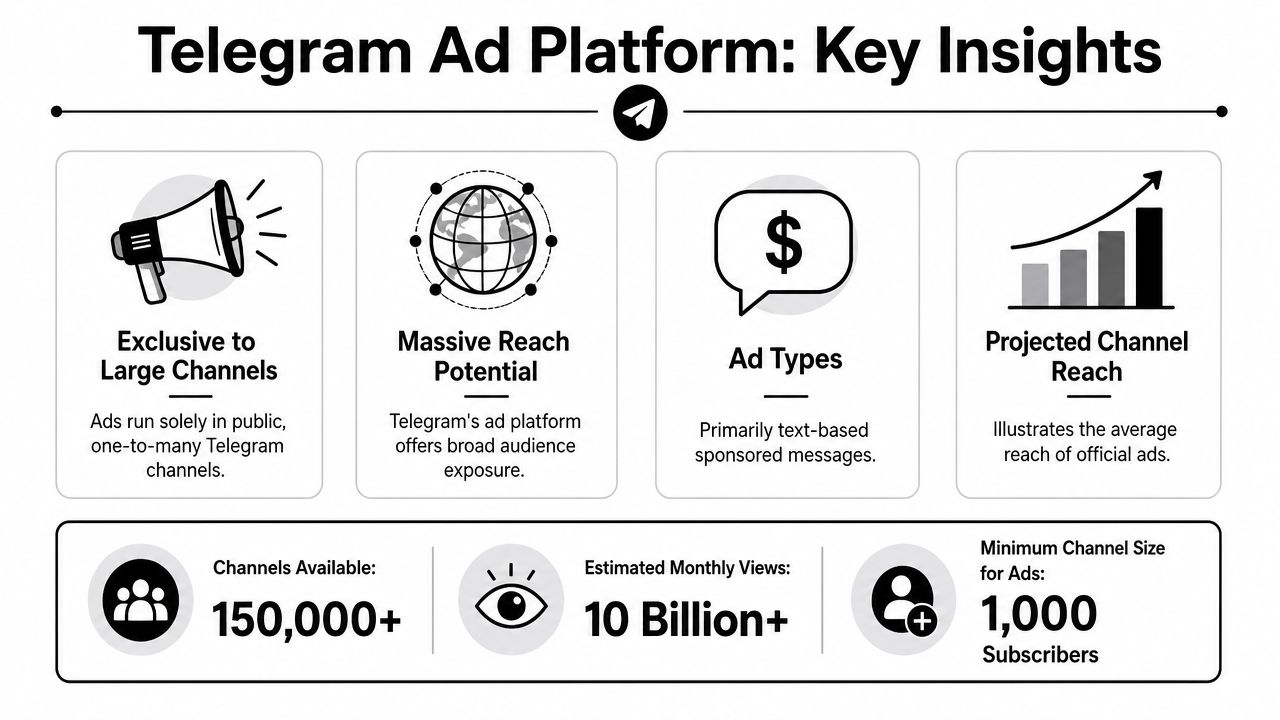
According to Telegram's own ads platform, 1 billion users generate 1 trillion views every month in public broadcast channels, and ads appear in public one-to-many channels rather than private chats, which makes the inventory a mass-distribution environment rather than a private messaging play (Telegram Ads platform).
The core format is a short sponsored message. It isn't built for long explanation, brand theater, or layered storytelling. That pushes teams toward tight positioning and a clear next step.
That simplicity can help disciplined teams. It forces the offer to stand on its own. If a product needs three paragraphs to explain why anyone should care, Telegram's official format is probably the wrong first move.
Telegram's getting-started documentation says ads are limited to 160 characters, bought in TON, and priced from a minimum CPM of 0.1 TON, roughly $0.34 to $0.36 per 1,000 impressions. The same documentation notes that advertisers can manage budgets and track views. Independent guides describe practical launch budgets beginning in the hundreds to thousands of euros, with one citing about €500 to start gathering meaningful campaign statistics and another noting setups around $2,000 in some cases (Telegram Ads getting started).
For a community manager, that creates two immediate realities:
For SaaS, the official Telegram advertising platform works best when the offer is easy to understand. Think free tools, waitlists, product updates, templates, or sharp problem-solution hooks. For gaming, it can support broad awareness around an event, but it won't replace creator-led hype. For Web3, it can drive attention, though moderation and trust at the destination need to be much stronger than the ad itself.
Short ads work when the community destination already answers the next question.
That is the practical lens. The official platform can buy attention efficiently. It can't fix weak onboarding, unclear messaging, or a support queue that collapses on launch day.
The unofficial Telegram market is where a lot of community-led growth happens. Teams buy posts directly from channel owners, work through specialist agencies, or use brokered placement networks. This side of Telegram feels more flexible because it is. It also creates more ways to waste money.
The biggest mistake is chasing size. A large subscriber count can look convincing and still produce low-value traffic if the channel is stuffed with bots, inactive followers, or an audience that only showed up for giveaways and never returned.
Independent Telegram ad guidance warns against treating large channels as automatic wins and argues that narrowly targeted placements in smaller, more engaged channels can perform 20 to 40 percent better than broader campaigns. The same analysis stresses that channel choice is the core buying decision because Telegram ad inventory centers on public channels with over 1,000 subscribers, while ecosystem expansion into banners and video through partners doesn't solve the quality problem by itself (New Age Agency on Telegram advertising).
That aligns with what community operators already know from moderation work. A smaller room full of relevant users is usually more valuable than a huge room full of tourists.
Before buying any unofficial placement, the team should inspect the channel like a moderator, not like a media buyer.
Buy the audience behavior, not the subscriber screenshot.
Agencies can help when a team lacks relationships, language coverage, or the time to negotiate with multiple admins. They can also package inventory in a way that hides weak channels if the buyer doesn't ask hard questions.
A careful operator asks agencies for channel logic, not just package pricing. Which channels fit the offer. Why those channels fit. What the posting style looks like. How the agency screens for low-quality inventory. If those answers stay vague, the campaign probably will too.
Unofficial placements can outperform the official system for launches that need context. They just require much tighter due diligence.
Most Telegram campaigns fail before the first impression. The usual cause isn't ad copy. It's a weak connection between the ad, the destination, and the support workflow waiting on the other side.
A community growth campaign needs one operating principle. Acquisition only counts if the community can absorb the people it attracts. That applies whether the team is promoting a SaaS tool, a game update, or a token launch.
The first decision isn't platform choice. It's the user action that matters after the click.
A few examples:
If that outcome isn't clear, the ad will pull in the wrong people. A broad "join our Telegram" message usually brings curiosity. It rarely brings qualified participation.
Use the official Telegram advertising platform when the message is compact and the team wants cleaner campaign mechanics. Use unofficial placements when context matters and the ad needs to feel native to a niche channel.
On Telegram, many teams should be stricter than they are on other platforms. Telegram traffic can arrive with strong intent, but that also means poor-fit users create support load quickly.
A useful mental model comes from adjacent channels. Teams already know they should avoid YouTube subscriber bots because fake growth poisons reporting and weakens downstream conversion. Telegram has the same operational risk. Fake audience signals distort planning, staffing, and attribution.
Don't send ad traffic into a cluttered group with no pinned guidance.
The destination should include:
Operator check: If a new user joins and asks the most obvious beginner question, the answer should be visible before a moderator has to type it.
In official ads, the message has to be tight. The best copy usually names the audience, the problem, and the next step with no fluff.
For unofficial placements, there is more room. That doesn't mean adding more words. It means adding context. Why this audience should care now. Why the offer belongs in that specific channel. Why joining is useful even if the user isn't ready to buy.
Here is a simple creative test framework:
A walkthrough on campaign setup can help teams think through format and execution details before launch:
Telegram campaigns shouldn't be judged on impressions alone. Community teams need post-click signals that reflect real onboarding quality.
Good operational measures include:
That is where Telegram starts to look less like an ad platform and more like a community operations system. The ad brings people in. The actual campaign starts after that.
The same Telegram channel logic produces very different campaign designs depending on the product. Community-led teams should build around the support burden and onboarding path each audience creates.
A SaaS company selling a developer or workflow tool is often better served by the official route when the pitch is clear and specific. The ad can promote a free tool, a technical guide, or a focused use case, then send users into a product education channel or a support-ready onboarding flow.
A strong message in this case is direct. It names the role, the pain point, and the benefit of joining. The expected outcome isn't raw member growth. It's qualified users who arrive already interested in one concrete problem.
Gaming teams often need more context than the official format allows. A direct placement in a genre-specific news channel, creator-run update feed, or title-adjacent community can work better because the post can frame the update properly.
The destination shouldn't be a generic main chat unless moderation is heavily staffed. A better option is a release-specific channel, patch-note hub, or support entry point where players can quickly understand what changed and where to report issues.
Smaller gaming communities often outperform larger general gaming channels because intent is sharper and conversation is closer to the actual game loop.
Web3 teams usually need two flows, not one. One flow handles awareness and excitement. The other handles questions from users who need help with wallets, access, eligibility, or process.
That makes a mixed approach sensible. Official ads can provide broad visibility for a public-facing message. Selective unofficial placements can then bring the project into relevant crypto or ecosystem communities where context matters more. The key operational move is separation. New users who want news, proof, or narrative shouldn't land in the same chaotic stream as users asking transaction and access questions.
Across all three categories, the winning pattern is the same. The ad channel matters. The support path matters more.
A Telegram ad can bring the right person into your orbit and still fail.
The failure usually happens in the first few minutes after the click. A new member joins, sees unclear instructions, overlapping conversations, spam, or no reply at all, and leaves before the team learns what they wanted. For community-driven projects, acquisition and support need to be planned as one operating system.
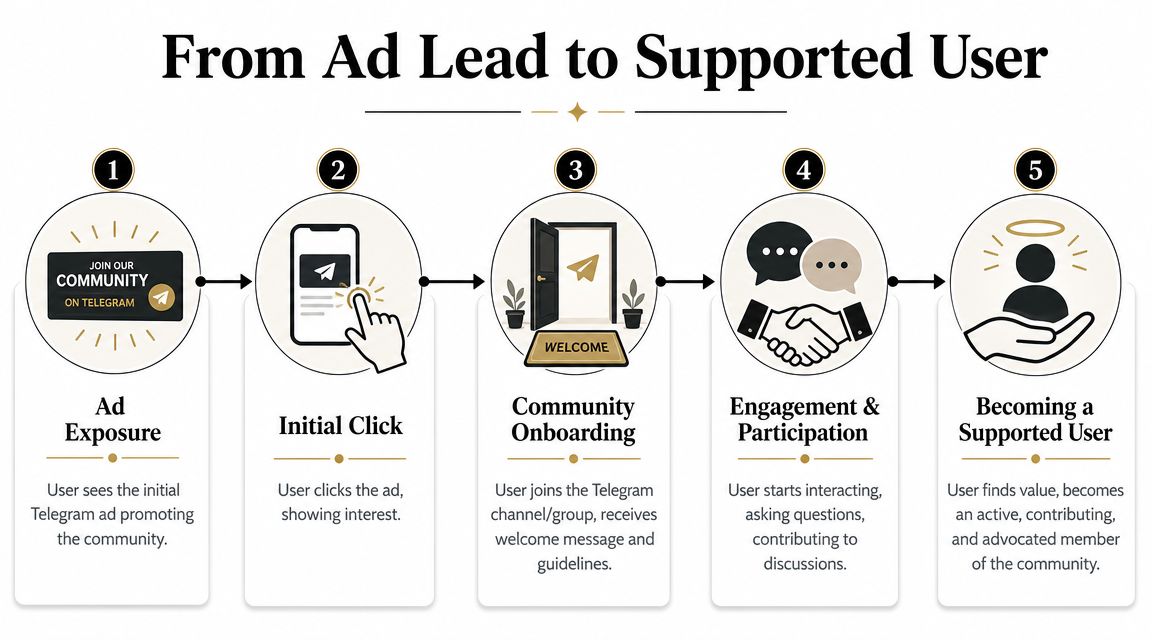
Teams that keep users do one thing early. They decide what should happen after the join.
A Telegram group should not carry every job at once. Public chat can handle lightweight conversation and social proof. Repeated product questions should route to documentation. Account issues, payment problems, wallet confusion, and bug reports usually need a tracked support flow with ownership and follow-up.
That is the same operational logic behind strong optimizing B2B lead nurturing. The ad creates intent. The next interaction determines whether that intent turns into activation or churn.
For community-led SaaS, gaming, and Web3 teams, the support layer usually needs four parts:
I have seen campaigns underperform for reasons that had nothing to do with targeting or creative. The core issue was handoff. The ad brought in relevant users, but the team dropped them into a crowded chat with no routing, no ownership, and no clear next step.
Mava gives teams a shared inbox for support across Telegram and other community channels, which helps turn messy incoming questions into trackable workflows.
The campaign is only successful when a new member gets help, completes the next action, and has a reason to stay.
.png)
.png)
.png)
