.png) Get Started
Get Started

Telegram has become one of the most powerful platforms for building deeply engaged communities. Direct, unfiltered access to your audience with no algorithm throttling reach is rare, and increasingly valuable. Telegram community building in 2026 is less about choosing the platform and more about knowing how to work it well. This guide walks you through every stage, from structure and setup to growth, engagement, moderation, and measurement.
Telegram surpassed 1 billion monthly active users in March 2025, and has since grown to 500 million daily active users as of late 2025. More importantly, those users opt in intentionally. Anyone who joins your group has made an active choice to be there, which fundamentally changes the dynamic of community management. The platform is especially dominant in crypto, tech, and Web3 circles, where privacy and speed are non-negotiable.
Telegram tends to attract members deeply aligned with a specific niche. A group of 5,000 passionate, intent-driven members will frequently out-engage a larger, more passive audience elsewhere. That intent is Telegram's core competitive advantage.
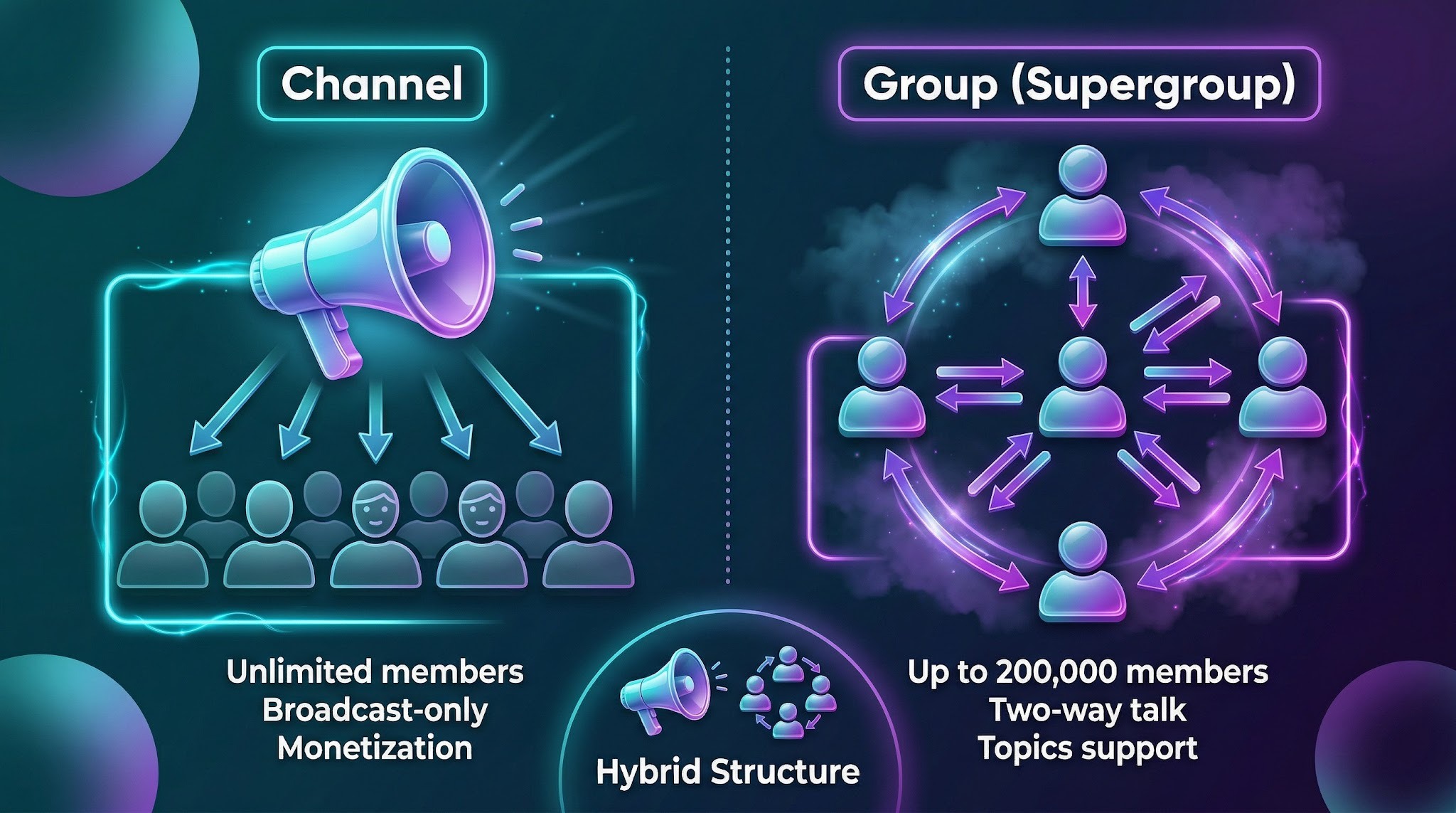
Before you build, you need to understand the difference between channels and groups, because that decision shapes everything downstream.
Channels are one-way broadcast tools. Only admins can post; members receive messages but cannot reply. They're excellent for announcements, product updates, and content distribution. Groups are two-way conversation spaces where members can post, reply, react, and interact with each other. This is where community actually happens. A Telegram group is messier and harder to manage, but far more engaging.
Many successful communities run both in tandem: a channel for broadcasts and a linked group for discussion. This hybrid structure is the recommended architecture once you scale past 1,000 members.
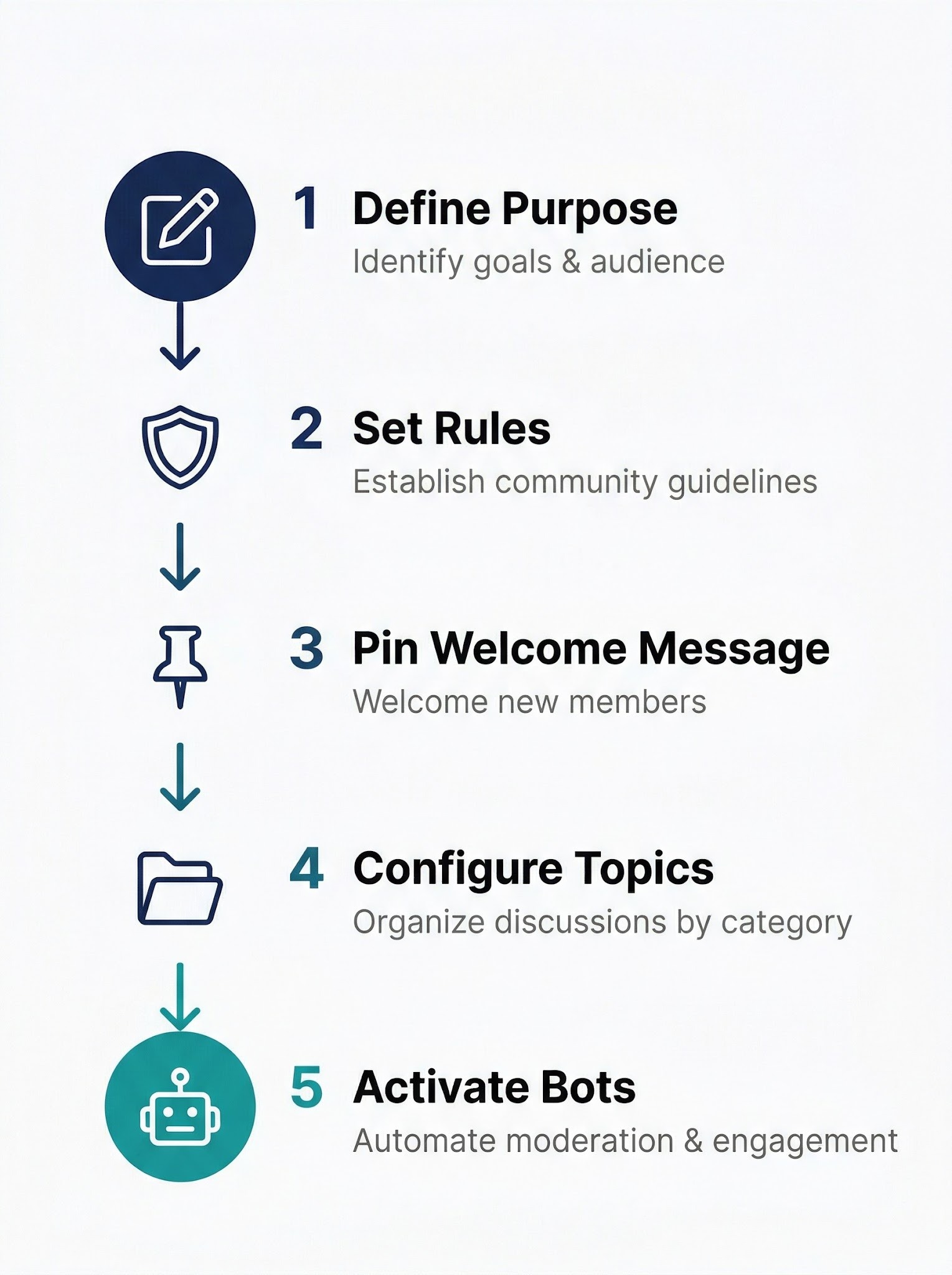
A Telegram community without a clear purpose will drift. Write a one- or two-sentence purpose statement explaining exactly who this community is for and what value it delivers. Your rules are equally vital. Clear, specific rules reduce the moderation burden because members can self-regulate when expectations are explicit.
Sample pinned welcome message:
> Welcome to \[Community Name\] - your home for \[topic/niche\] discussion, updates, and support. Before posting, please read our rules:
>
> 1. No spam or unsolicited self-promotion
>
> 2. No price speculation or financial advice
>
> 3. Respectful discourse only - harassment will result in an immediate ban
>
> 4. Use the correct Topics channels for questions, announcements, and general chat
>
> 5. Scam reports: DM a mod immediately. Admins will never DM you first asking for wallet details or funds.
>
Pin this as the first thing new members see. A warm, organized onboarding experience builds early loyalty and sets the tone that this is worth sticking around for.
Once your community grows past a few hundred members, structure becomes critical. Topics (available in supergroups) let you divide conversations into dedicated threads so announcements don't get buried under memes. For communities exceeding 10,000 members, Topics are essentially required. Pin your rules, your most recent important announcement, and evergreen resources like FAQs.
Bots are where Telegram's organizational power opens up. Use them to automate welcome messages, verify new members, moderate spam, schedule polls, and handle basic support questions. A well-configured bot absorbs the majority of inbound repetitive questions before they reach a human admin.
Cross-promotion is one of the most reliable growth channels. Cross-promoting in Web3 Discord servers and niche Reddit communities drives initial member influxes. Telegram discovery platforms and directories are worth listing on, especially in high-search categories. Referral contests ("invite 3 friends" for exclusive perks or Telegram Stars) work well for member-led expansion.
Public group descriptions are indexed by search engines, so optimizing them for discoverability compounds over time. Organic content remains the most sustainable long-term tactic. Sharing exclusive insights or early access announcements gives existing members a reason to bring their networks in.
Referral programs work well on Telegram because the ask is low-friction. Members share a join link; the challenge is giving them a compelling reason to do it. Tiered access, exclusive roles, early product drops, or recognition for top referrers can generate real momentum.
Strategic partnerships with influencers or projects in your space accelerate growth considerably. Co-hosting an AMA, running a joint giveaway, or collaborating on a topic-specific discussion attracts new members who convert at higher rates than cold outreach because they arrive with pre-existing trust.
Subscriber counts are vanity metrics if members aren't engaging. Post 3 to 5 times weekly, mixing updates, polls, and value content to sustain activity without fatigue. Consistency is the foundation. Members who learn to expect valuable content at predictable intervals will keep showing up.
Polls are one of the easiest high-engagement formats on Telegram. They take seconds to participate in and signal that member opinions matter. Channel engagement rates average 20 to 30%; top-performing broadcasts using polls, quizzes, and multimedia can achieve engagement rates above 50%.
Q&A sessions, whether live in the group or structured through a bot, are powerful for building credibility. When founders or team members answer member questions directly, it reinforces the community's value in a way no broadcast message can.
Telegram Stories increase visibility for channels, particularly for attracting members who are browsing. Telegram Stars, the platform's virtual currency, can reward top contributors or fund community initiatives, adding a recognition layer that encourages ongoing participation. For communities scaling beyond 1,000 members, the hybrid channel-plus-group structure combined with consistent content cadence is the playbook that reliably drives growth.
Trying to moderate a high-volume Telegram group alone is a fast path to burnout. Build a team and distribute responsibility clearly. Identify trusted, active members early and assign defined roles: some admins handle welcome and onboarding, others manage rule enforcement or content scheduling.
Clear documentation makes delegation work. Write down how to handle common situations: responding to spam, what constitutes a ban-worthy offense, how to escalate edge cases. When every admin works from the same playbook, enforcement stays consistent and members trust the rules apply equally to everyone. These are core Telegram group best practices that prevent small issues from compounding.
High-volume communities generate high volumes of support requests. Without a clear resolution path, they pile up fast. Mava natively integrates with Telegram and connects your community alongside Discord, Slack, web chat, and email, pulling all support requests into a single shared inbox so nothing slips through.
Mava's AI handles up to 50 to 60% of common queries automatically across more than 100 languages, with seamless human handover for complex issues. This prevents mod burnout as your community scales from hundreds to thousands of members. Communities like EigenLayer, Alchemy, and 1inch have used this infrastructure to manage support at scale, see Mava's community case studies for details. Mava has supported 3,000+ communities and processed 3.5M+ support tickets. Get started with Mava to see how it fits your community's support needs.
For spam, configure bots to automatically filter links from new members until they reach a minimum activity threshold. Flag repeated similar messages and new accounts with no profile photos. Most spam gets caught automatically before a human sees it. For rule violations, a three-strike system (verbal warning, temporary mute, then ban) is predictable and fair. Handle violations privately wherever possible to avoid public confrontations that disrupt the group.
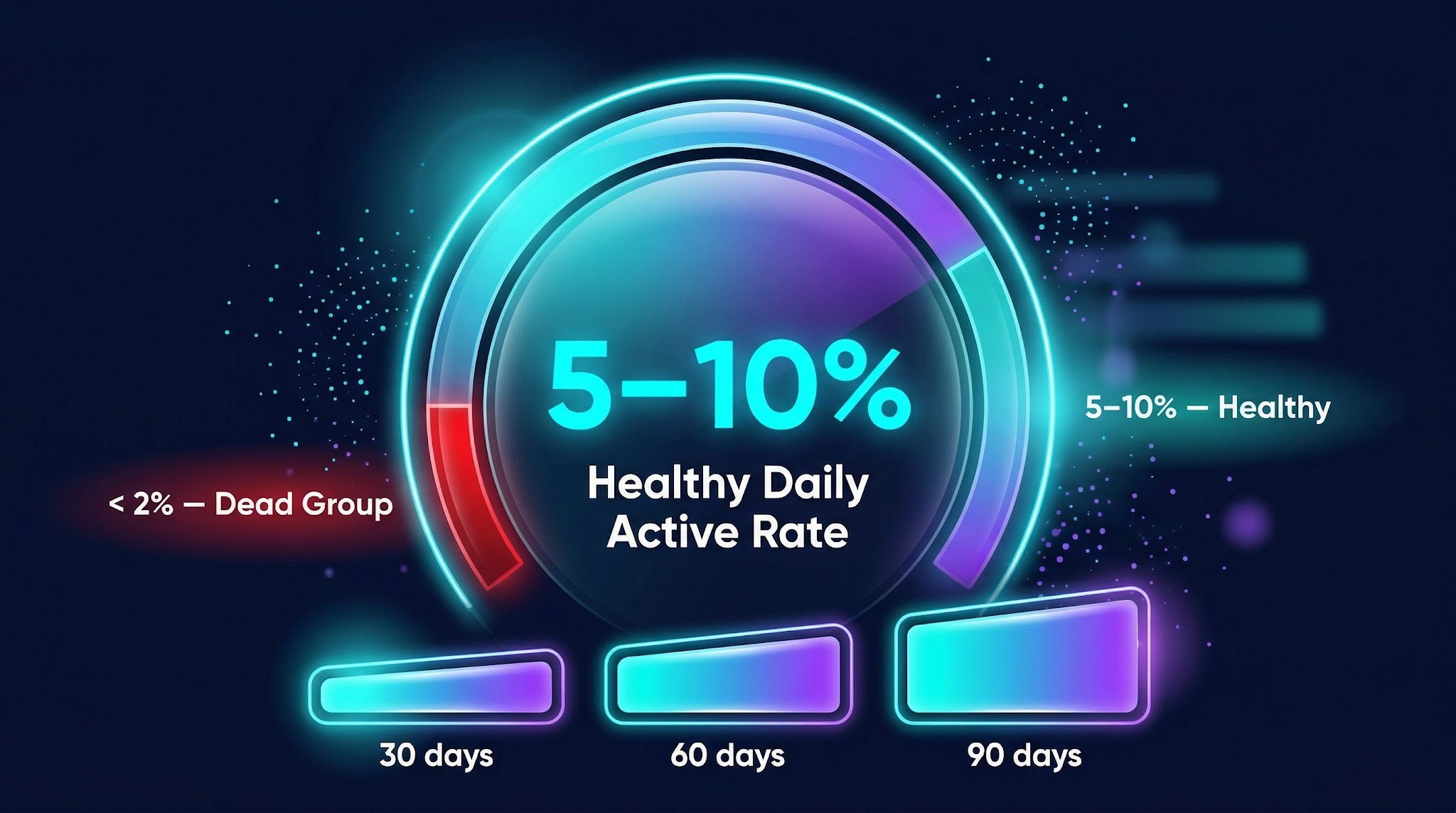
Vanity metrics like total member count tell you almost nothing on their own. For groups with 500+ members, a 5 to 10% daily active rate is healthy. Below 2% signals an effectively dead group.
Member retention is arguably the most important metric. A community adding 500 new members a month but losing 450 is barely growing and may be masking a serious experience problem. Track cohort retention at 30, 60, and 90 days to see whether your onboarding actually works.
Native Telegram analytics are limited to basic views and member activity. Platforms like Mava provide support-specific metrics, including response time and resolution rates, as a complement to growth analytics. Response time directly affects member satisfaction and is one of the most consistent predictors of churn.
Use this to audit your community regularly:
How do I create a Telegram group from scratch? Open Telegram, tap the pencil icon, and select "New Group." Add at least one contact, then invite members or share a join link. Before promoting, configure settings, add rules, and pin a welcome message.
What's the difference between a Telegram channel and a group? A channel is a one-way broadcast tool where only admins post. A group is a two-way conversation space where all members can participate. Channels suit content distribution; groups suit community interaction. Many operators run both in parallel.
How many admins can a Telegram group have? Telegram supergroups support up to 50 admins. Each admin can be assigned custom permissions, so you can give moderators only the access they need without full admin rights.
Can you monetize a Telegram group without a channel? Yes. Paid access groups are supported natively on Telegram, allowing you to charge a subscription fee for entry. You can also use your group as a distribution channel for paid products, courses, or services. Telegram Stars let members tip contributors directly. Full channel monetization features (subscriber analytics, broader paid subscription tools) are richer on channels, but group-only monetization is viable.
What's the difference between a Telegram bot and a Telegram mini app? A Telegram bot is an automated account that responds to commands, sends messages, and performs actions within chats. A Telegram mini app is a full web application that runs inside Telegram's interface, offering a richer UI experience for things like games, storefronts, or dashboards. Bots handle automation; mini apps deliver interactive experiences.
How do I grow my Telegram community beyond friends and colleagues? Cross-promote in Web3 Discord servers and niche Reddit communities, list in Telegram directories, and run referral incentives. Consistent, valuable content is what sustains growth over time.
How do I manage high volumes of support requests in a Telegram community? Using a dedicated support platform like Mava's Telegram integration centralizes all incoming requests in a shared inbox, automates responses to common questions, and tracks resolution metrics, becoming essential as communities scale past a few thousand active members. Review Mava's pricing to find the right plan for your community's size.
.png)
.png)
.png)
