.png) Get Started
Get Started
A familiar support failure keeps repeating. The team builds a polished FAQ page, links it in the footer, maybe even pins it in the community, and still the same questions flood Discord, Telegram, email, and web chat every day.
That usually isn't a user problem. It's a format problem.
Most advice about the frequently asked questions format still assumes a web page is the final destination. That assumption is outdated. 60% of customer service interactions are now handled by AI or automation, yet most FAQ guidance still ignores the context-aware, conversational snippet structure needed for instant answers in chat-based channels like Discord, Slack, and Telegram, without human handoff, according to Gorgias on FAQ examples and automation trends.
Community teams feel this gap first. Users don't want to leave a channel, search a knowledge base, and translate a long article into action. They want an answer where the question was asked, in language that fits the moment.
That changes how FAQ content should be designed. A modern FAQ isn't a static list. It's a reusable layer of support content that can be surfaced on a website, parsed by AI, delivered in a bot reply, referenced by a moderator, and expanded into a guide when the issue is more complex. Teams working with scraped docs, exported ticket logs, and scattered support content often need a cleanup step before any of that works well, which is why resources like these Firecrawl alternatives for LLM data extraction can be useful when assembling source material for a cleaner knowledge system.
The old FAQ page solved an old internet problem. The current support environment is different.
Users now move between product UI, web chat, Discord threads, Telegram groups, and inboxes without thinking about channel boundaries. Support teams, however, often still publish one long FAQ page and expect it to serve every context equally well. That mismatch creates the chaos many community managers live with: duplicate questions, inconsistent answers, volunteer moderators improvising replies, and support agents rewriting the same message over and over.
A better approach starts with a different definition. The frequently asked questions format should be treated as a delivery structure, not a page template. The same answer may need one version for a searchable help center, another for a bot command, and a shorter one for an embedded widget.
Practical rule: If an answer only works when someone reads the whole page around it, it isn't ready for chat-based support.
That's why static, web-only FAQ advice breaks down for community-driven companies. Modern support requires answers that are short enough to retrieve quickly, clear enough to stand alone, and structured enough for automation to use accurately. The format matters as much as the content.
The term FAQ has old roots. It originated around 1988 on ARPANET-era servers as a way to organize community discussions, then evolved again when Google introduced FAQ rich results in 2018, turning the format into a machine-readable search asset, as described in Wikipedia's history of FAQs. That history matters because it shows the format has never been fixed. It adapts to how people find information.
Today, the next adaptation is obvious. A single FAQ page is too narrow. Teams need a system.
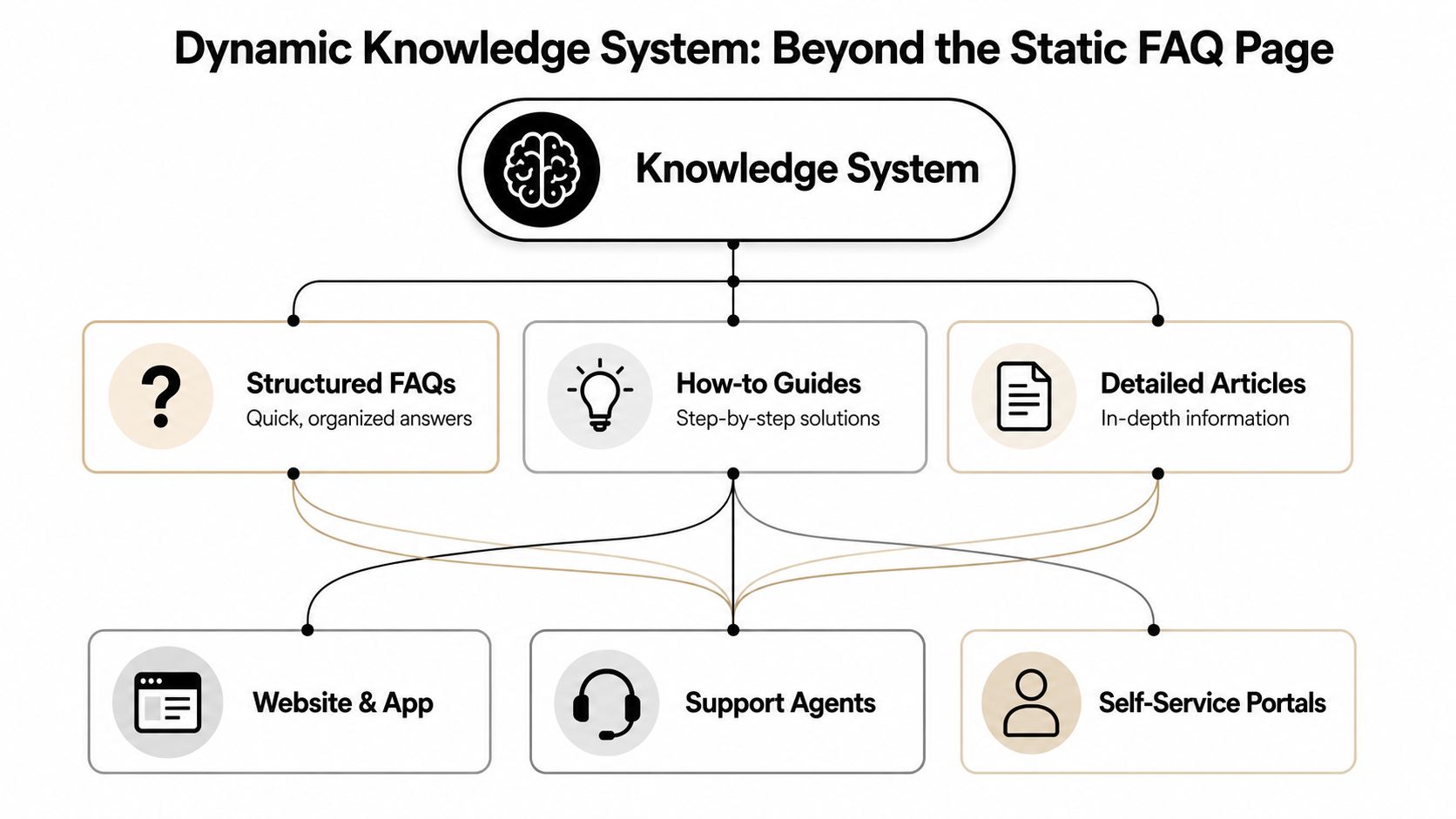
A dynamic knowledge system gives support teams one source of truth, then lets them publish and reuse answers in multiple formats. Instead of storing help as isolated pages, it connects:
Many teams achieve improvement once they move from “write more FAQ entries” to “design a knowledge architecture.” A broader knowledge management best practices resource can help frame that shift operationally, especially when support content spans docs, agents, and community moderators.
Static FAQ pages usually belong to marketing or content. Dynamic knowledge systems belong to the whole support operation.
That changes the maintenance model:
A FAQ page gets published. A knowledge system gets maintained.
That distinction affects quality. Pages go stale because no one owns the update loop. Systems stay useful because they're tied to active support workflows.
The strongest frequently asked questions format usually shares three characteristics:
When teams adopt those principles, the FAQ stops being a dusty appendix and becomes infrastructure.
Most weak FAQs fail before the writing even starts. The team guesses what users ask, writes from an internal point of view, and publishes answers that sound complete but don't resolve the issue.
Effective FAQ formats work differently. Organizations need to collect, track, and analyze real user questions before publishing. Best practice also calls for organizing content into sections and keeping answers short, based on patterns found by counting common words in user inquiries, according to A List Apart's guidance on FAQs.
The right question usually sounds less polished than the internal version.
Support teams often write:
Users usually ask:
The second version is easier to search, easier to scan, and easier for AI to match.
A practical workflow looks like this:
For teams that need examples of how FAQ libraries are presented to end users, these FAQ page examples are useful as a visual benchmark. The writing standard should still come from real support language, not from copying another company's phrasing.
A modern FAQ answer has to work in more than one place. It may be shown in a search result, inserted into a bot response, or pasted by an agent into a thread. That means the answer should make sense without surrounding context.
Good answers usually include:
Field note: If a moderator has to rewrite your FAQ answer before sending it, the answer is too long, too vague, or too internally written.
CharacteristicTraditional FAQ AnswerModern Knowledge SnippetLengthParagraph-heavyShort and self-containedPoint of viewCompany-centricUser-centricStructureNarrative explanationDirect answer firstChannel fitBest on a web pageWorks in web, chat, and AIRetrievalRequires reading nearby textCan stand alone in a bot or search resultMaintenanceOften duplicated across pagesEasier to reuse from one source
Instead of this:
Use this:
The second version is easier for humans. It's also easier for a chatbot, agent assist tool, or search engine to parse correctly.
One answer rarely belongs in one format only. The question “How do refunds work?” needs different packaging on a website, in Discord, and inside a small web chat window.
The website version should support browsing and deeper reading. Category pages, related links, screenshots, and policy detail belong in this context.
A strong web FAQ entry usually includes:
This format works well for users doing deliberate research. It's weaker for users who need a quick answer mid-conversation.
Community channels need retrieval speed more than page depth. Long FAQ prose gets ignored in fast-moving chats.
The most useful formats here are usually:
!refunds or !pricingThe answer itself should be short enough to post directly in chat. If it requires more detail, the bot or moderator can add one follow-up link.
Example structure for Discord or Telegram:
This format respects the channel. Users stay in conversation instead of being bounced to a wall of text.
A chat widget has the least room and the highest urgency. Answers should feel conversational and compressed.
What works:
What doesn't work:
Users in chat don't want a document. They want the next useful step.
Different channels reward different behavior:
ChannelBest forMain strengthMain weaknessWebsite knowledge baseResearch and documentationDepth and discoverabilitySlower in live support momentsDiscord and TelegramRepetitive public questionsFast retrieval in-channelHarder to handle nuance in one replyEmbedded web chatImmediate assistanceConversational and efficientVery limited space for detail
The format should match user intent at that moment, not just the content team's preferred publishing destination.
Visibility and usability have to work together. Teams sometimes over-focus on keyword placement and forget that a confusing FAQ won't reduce support load even if it ranks. Others build clean help content but skip the technical structure that helps search systems and AI tools understand it.
Implementing FAQPage structured data in JSON-LD on support pages increases the likelihood of appearing in AI Overviews by 3.2x, and that same schema helps AI support agents retrieve precise question-answer pairs with low latency, according to Helply's FAQ schema guidance.
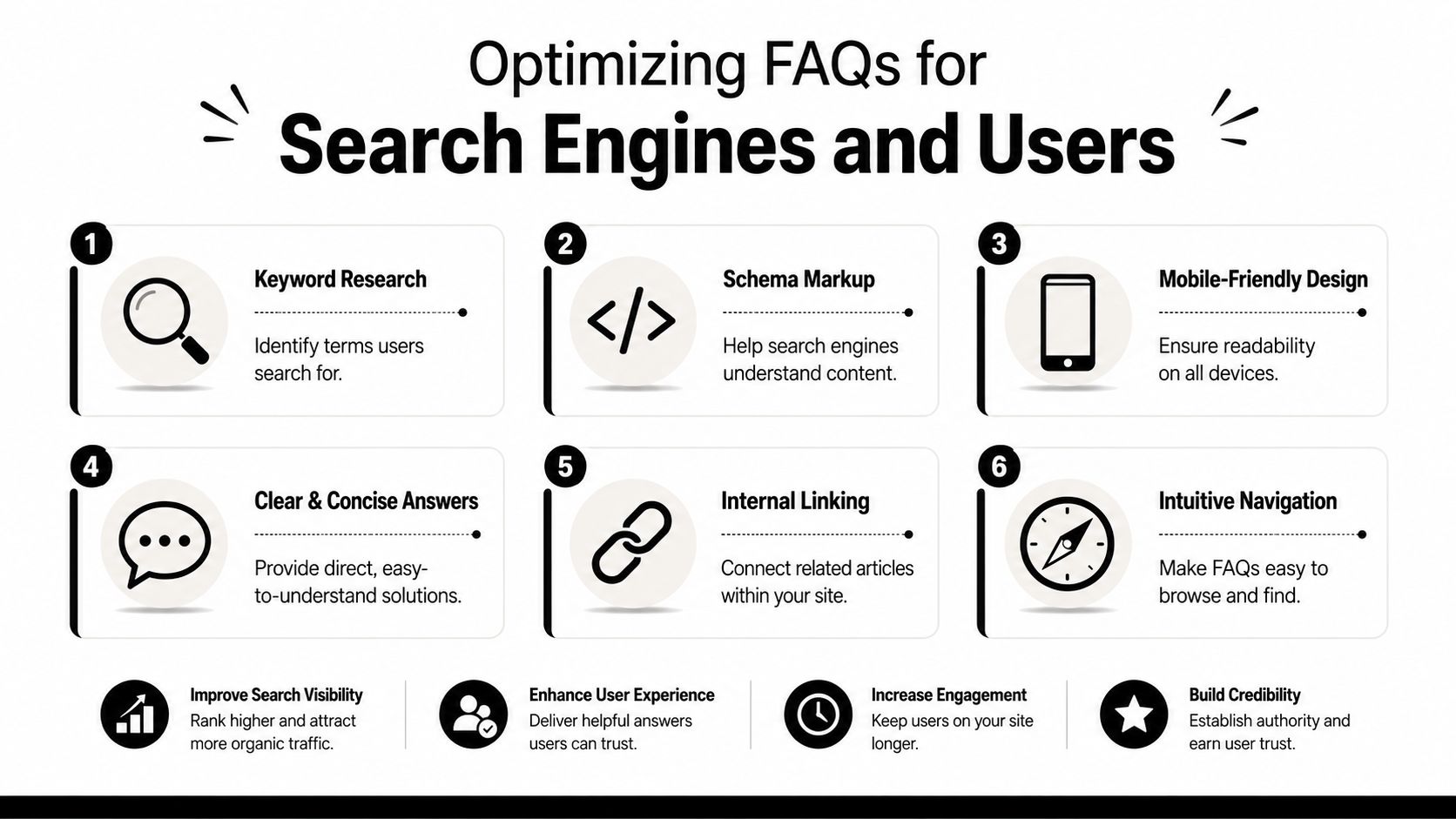
Schema helps, but poor page design still kills findability. A usable FAQ page usually needs:
Teams trying to improve search behavior beyond standard FAQ ranking may also find this guide to PAA visibility for businesses useful, especially when deciding how question phrasing maps to broader search discovery.
The implementation detail many teams miss is simple but important. The visible page content and the JSON-LD must match. If a question appears in schema, that same question should appear on the page.
That matters for two reasons:
A practical schema workflow:
An FAQ can be perfectly marked up and still fail users. The common failure pattern is a long list of accordion items with no search, weak grouping, and no route to a more detailed explanation.
A better frequently asked questions format balances retrieval and resolution:
Search rule: Ranking helps users arrive. Structure helps them leave with an answer.
When teams optimize for both, the FAQ becomes more useful to Google, internal site search, support bots, and actual people.
Once FAQ content is structured well, it stops being documentation only. It becomes operating data for support automation.
That's the payoff. The same question-answer snippets that work on a page can also power a bot in Discord, Telegram, Slack, or web chat. The AI handles the repetitive layer, and human agents step in for exceptions, edge cases, and emotionally sensitive conversations.
AI support tools perform better when knowledge is:
If the knowledge base is vague, duplicated, or buried in long-form prose, the bot will struggle. If the structure is clean, retrieval gets much more reliable.
This is also why broader thinking around AI solutions for professional workflows matters. The strongest systems don't treat AI as a writing shortcut. They treat it as a layer that depends on well-organized source material.
Not every question should be automated. The strongest setups use AI for the repetitive front line, then escalate when confidence drops or account-specific action is required.
Typical automation-friendly topics include:
Human takeover still matters for disputes, unusual bugs, refunds with exceptions, security concerns, and anything that needs judgment.
One practical example is knowledge base integration for AI support workflows, where the knowledge source feeds support responses across channels. Tools like Mava use imported knowledge bases to answer repetitive questions in community and chat environments, then route more complex issues to people when needed.
The frequently asked questions format matters here more than often anticipated. Better formatting doesn't just improve self-service pages. It improves routing, agent speed, automation accuracy, and consistency across channels.
A modern FAQ shouldn't live as a forgotten page in the footer. It should power support where users already ask for help. Mava is one option for teams that want to turn an existing knowledge base into AI-assisted support across Discord, Telegram, Slack, web chat, and email, while keeping human handoff available for the questions automation shouldn't handle.
.png)
.png)
.png)
