.png) Get Started
Get Started
New signups look good in the dashboard. The team celebrates a strong launch, a paid campaign that finally converts, or a product update that gets people talking in Discord and Slack. Then renewal month arrives, and the numbers tell a different story. Accounts go quiet, power users disappear, and customers who seemed active never turn usage into lasting value.
That pattern usually isn't a marketing problem. It isn't even mainly a support problem. It's a customer success for SaaS problem.
Community-driven SaaS companies feel this faster than most. Users don't just submit tickets through a portal anymore. They ask questions in public channels, DM moderators, react with emojis instead of filling out surveys, and form strong opinions about the product long before a renewal call ever happens. If the post-sale motion still depends on waiting for tickets and checking basic satisfaction scores, churn will keep showing up as a surprise even when it shouldn't.
A SaaS company can add customers every month and still build a fragile business. That happens when the team treats the sale as the finish line instead of the handoff to value delivery. In subscription businesses, revenue doesn't compound because people bought once. It compounds because they kept getting outcomes worth paying for.
Traditional support models break here. Support waits for pain. Customer success looks for stalled progress before the customer names it as a problem. That's the difference between answering tickets and protecting recurring revenue.
Teams usually notice churn too late because they organize around internal functions instead of customer outcomes. Product handles bugs. Support handles questions. Sales handles renewals. Nobody owns whether the customer changed behavior, adopted the right workflow, and got the result they expected when they signed.
Churn rarely starts at cancellation. It starts earlier, in quieter moments:
A lot of retention work is really diagnosis. The team has to understand what “healthy” looks like for each customer type and catch the gap between activity and outcomes.
Practical rule: If churn feels sudden, the company is probably measuring too late in the lifecycle.
This is why customer success shouldn't sit in the business as a reactive service desk with a nicer title. It should operate as a post-sale system for adoption, risk detection, and expansion. A useful starting point is to review practical retention work like this guide on how to improve customer retention, then map those ideas to the moments where customers lose momentum.
When customer success owns retention properly, the team stops asking, “Did we answer fast enough?” and starts asking, “Did this account move closer to value this week?” That shift changes operating behavior.
A strong CS function will:
For SaaS leaders, that's the essential point. Churn is often the visible symptom. The deeper issue is that no one built a repeatable system for helping customers succeed after the contract starts.
Customer success isn't support with a quarterly business review attached. It's a philosophy: the company accepts responsibility for helping customers realize value consistently enough that renewal becomes the default outcome.
Support is the emergency room. It matters, and customers need it. But customer success is closer to a personal trainer. It creates structure, checks form, prevents avoidable setbacks, and keeps the customer moving toward the result they signed up for.
The market has moved in that direction fast. The global Customer Success Platforms market was valued at approximately $1.86 billion in 2024 and is projected to reach $9.17 billion by 2032, growing at a 22.1% CAGR, according to Custify's customer success statistics roundup. That growth reflects how seriously SaaS companies now treat proactive health management and retention automation.
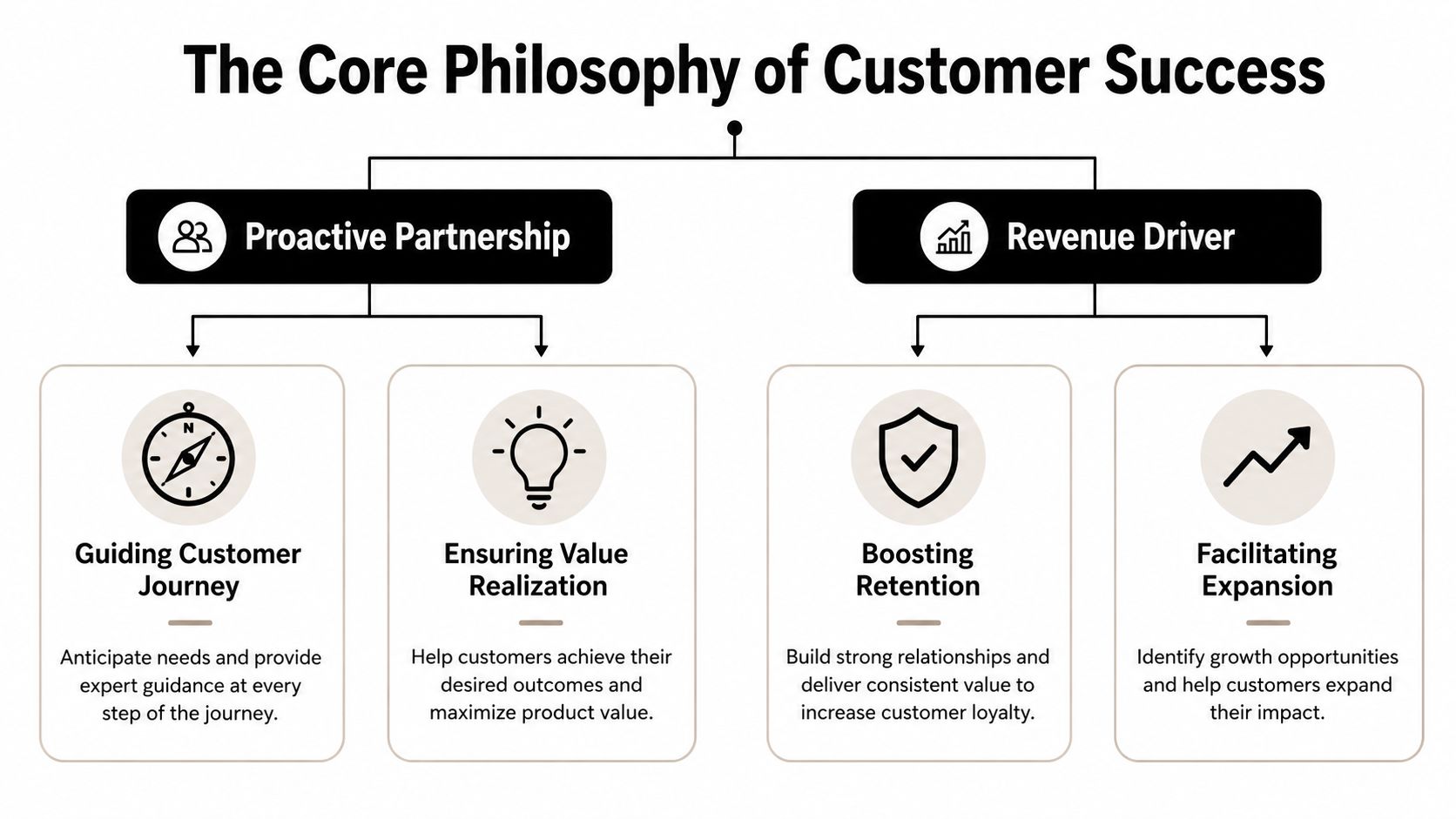
The strongest CS teams don't wait for accounts to ask for help. They guide the customer through a sequence that makes progress visible and repeatable.
That usually includes:
In community-led SaaS, proactive partnership also means showing up where users already are. A public Discord thread about a broken workflow can reveal more risk than a clean support queue.
Customer success also has a commercial job. Not a salesy one. A commercial one rooted in outcomes.
The four pillars usually look like this:
PillarWhat good looks likeOnboardingCustomers reach useful value quickly, with minimal confusionAdoptionTeams use the workflows that map to the promised outcomeExpansionAdditional seats, features, or plans follow demonstrated valueAdvocacySuccessful customers contribute references, referrals, and community credibility
A weak CS program often gets trapped in courtesy work. Lots of check-ins, lots of friendliness, not much behavior change. A strong one creates momentum. The customer adopts the product more thoroughly because the team keeps connecting usage to business progress.
Customer success works when the customer would struggle to explain their current process without your product in it.
That standard is higher than satisfaction. It means the software became operationally meaningful. Once that happens, retention improves for the right reason. The customer isn't staying because renewal was easy. They're staying because leaving would mean losing working systems and proven outcomes.
Executives don't fund customer success because it sounds thoughtful. They fund it when it moves the core SaaS economics. Three metrics usually matter most: MRR churn, net revenue retention, and expansion revenue. They tell different parts of the same story.
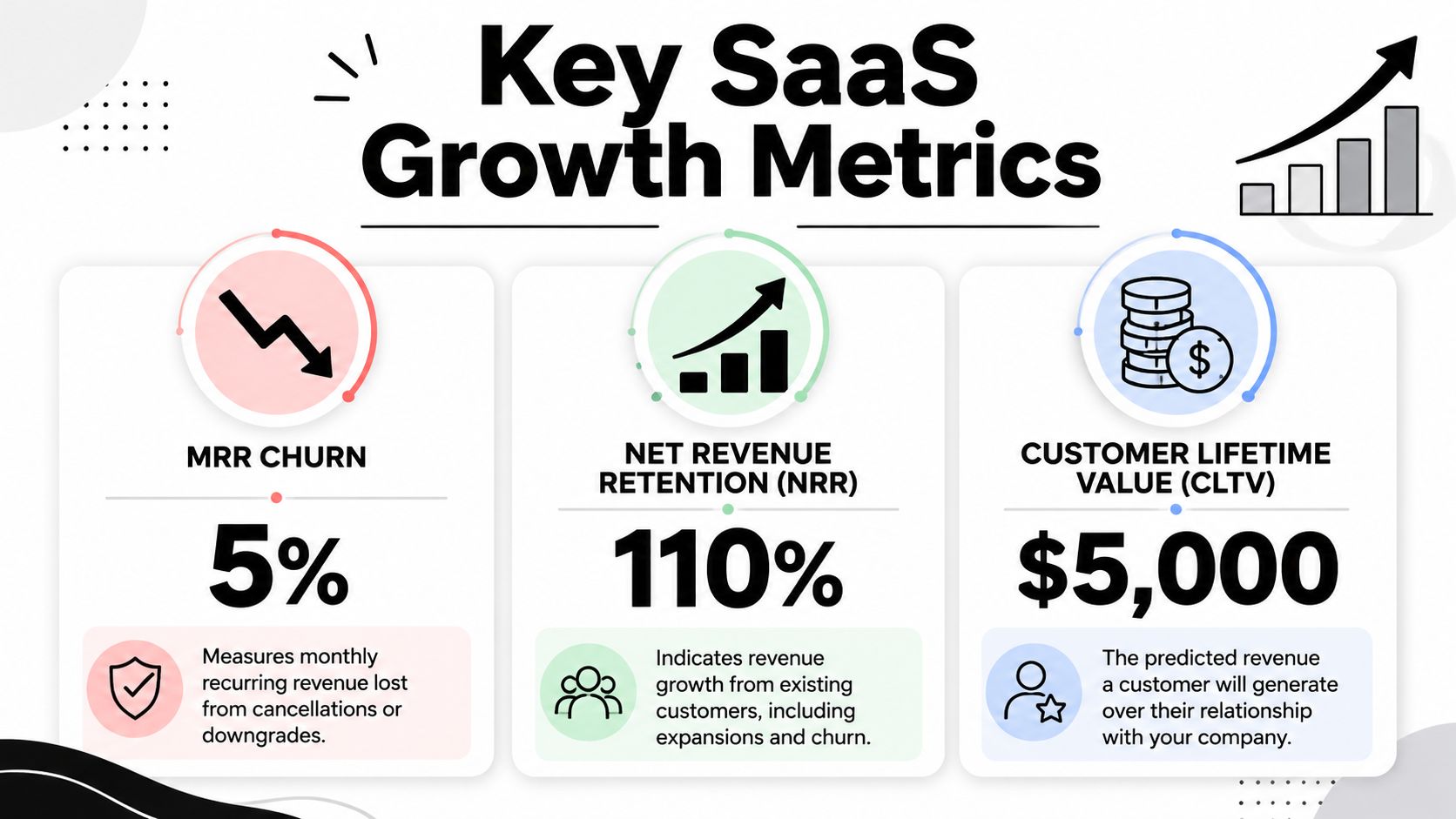
The infographic above uses example values, but the point isn't the sample number on the graphic. The point is what each metric reveals operationally.
MRR churn shows how much recurring revenue the company is losing from cancellations and downgrades. This is the clearest signal that customers aren't sustaining value.
Net revenue retention is the stronger executive metric because it combines contraction, churn, and expansion. When it trends well, the business is proving that existing customers are growing, not merely surviving.
Expansion revenue shows whether customer success is creating enough product adoption and organizational buy-in to justify a broader footprint.
For leadership teams trying to tie this into broader financial planning, a useful companion resource is this 2026 guide to business success, which frames recurring revenue in terms that are easy to connect back to retention strategy.
Financial metrics matter, but they lag. By the time MRR churn moves, damage has already happened. Customer success needs earlier indicators that are close enough to daily behavior to be useful.
That is where many teams still underperform. In AI-driven SaaS, the most effective shift is moving from generic satisfaction scores to dynamic engagement scores, which AI calculates by synthesizing website visits, social interactions, and product usage telemetry to predict drop-off points and trigger interventions, as explained in EverAfter's analysis of evolving customer success metrics.
That matters in community-first products because engagement doesn't live in one system. A healthy account may be active in the product, active in Slack, and internally frustrated in support. A weak metric model sees logins. A strong one sees behavior across the full customer relationship.
A practical scorecard usually includes:
For teams refining that layer, this overview of customer satisfaction metrics is useful as a baseline, but basic CSAT alone won't explain retention in a modern SaaS environment.
A healthy score should help a CSM decide what to do next. If it only labels the account green or red, it's incomplete.
The best KPI model does two jobs at once. It tells leadership whether the revenue engine is durable, and it tells the CS team where to intervene before churn becomes visible in finance.
Most SaaS retention problems can be spotted in the first stretch of the customer lifecycle. Not because every customer who struggles early will churn, but because weak onboarding creates bad habits that compound later. The goal isn't to “complete onboarding.” The goal is to get the account to a credible first result and then turn that result into repeatable usage.
A good playbook shouldn't read like a checklist exported from project management software. It should tell the team what to do when a customer is progressing, stalling, or pretending to progress.
The first onboarding mistake is over-teaching. Teams try to explain the whole platform, every setting, every edge case. Customers don't need a tour. They need enough structure to achieve the first meaningful outcome in their own environment.
That means the playbook has to answer four practical questions:
In community-driven SaaS, first value often happens outside a polished implementation call. It might be a moderator resolving an issue in Discord faster than before, a product team answering repeated Slack questions with one reusable workflow, or a customer seeing that public questions no longer turn into support chaos.
A simple onboarding sequence often works better than a complex one:
A lot of teams think an account is healthy because users keep logging in. That assumption causes real damage. According to Rocketlane's customer success overview, 78% of SaaS teams still rely on vanity metrics like login frequency, and a 2024 study found that companies tracking critical path workflows and role-level adoption reduced churn by 22% compared to those measuring only volume.
That should change how adoption playbooks are built. The question isn't “Are they active?” It's “Are they using the behaviors that produce the promised result?”
Field note: High usage can hide poor adoption when customers spend that activity compensating for a bad process.
A stronger adoption playbook tracks workflow quality, not just quantity. For example:
Adoption viewWeak signalStrong signalUser activityFrequent loginsCompletion of the core workflowTeam rolloutOne champion activeMultiple roles using the product correctlyFeature adoptionMany features clickedThe right features used in the right orderCustomer health“No complaints”Clear progress toward the customer's stated outcome
That distinction is where most re-engagement work should start.
After the initial launch, this walkthrough gives a useful visual on how teams can structure training and follow-through:
Once onboarding is complete, adoption work becomes rhythm, not ceremony. The strongest teams use lightweight, repeatable motions:
Not every account needs a high-touch motion. But every account needs a defined path from initial setup to durable usage. Without that, customer success turns into well-meaning improvisation.
The right CS team isn't the biggest one. It's the one built for the company's stage, product complexity, and customer behavior. Early-stage SaaS teams often hire too late, then overcorrect and hire too broadly. Both mistakes are expensive.
A modern team usually needs three capabilities: someone to own relationships and risk, someone to drive implementation, and someone to build the operating system behind the work. Those capabilities may sit with three people or one person wearing multiple hats. The design depends on volume and maturity.
A simple model works well for most SaaS companies:
RolePrimary responsibilityCommon failure modeCustomer Success ManagerOwns health, adoption, renewal readiness, and coordination across teamsBecomes a reactive ticket escalatorOnboarding or Implementation SpecialistGets customers live and aligned on early milestonesOptimizes setup without securing first valueCS OperationsBuilds health scores, lifecycle automation, reporting, and process disciplineBecomes a tooling admin detached from customer reality
A lot of startups don't need all three as separate hires on day one. They do need the functions covered. If nobody owns implementation quality, onboarding drifts. If nobody owns operational design, the team can't scale beyond heroics.
Dedicated CSMs make sense when accounts are complex, strategic, or politically layered. Pooled models work better when customers need fast guidance, light intervention, and strong automation. Community-led products often benefit from a hybrid structure where a pooled team handles broad engagement while named owners focus on high-risk or high-value accounts.
What doesn't work is pretending every customer needs the same service model. That usually creates one of two outcomes: enterprise theater for small accounts, or neglect for strategic ones.
A practical decision framework looks like this:
Many young SaaS companies get customer success wrong. They hire for upsell stories before they can reliably support and onboard customers. According to a 2025 analysis by ChurnZero, 65% of Seed-stage CS failures happened because teams tried to drive expansion revenue before establishing foundational support, and the successful pattern used a waterfall budget model tied to product maturity, as summarized in this customer success trends roundup.
That finding matches what good operators already know. Expansion is hard to scale on top of customer confusion.
Hire in sequence. Reactive support first, structured onboarding second, outcome-led success third, expansion specialization last.
For founders and heads of CS, the actual question isn't “When should the first CS hire happen?” It's “What post-sale failure is costing the business most right now?” Hire against that constraint. Then design the next role only after the previous gap is completely covered.
A modern customer success team can't run on spreadsheets, scattered inboxes, and a CRM field updated before renewal calls. The job now spans product telemetry, support behavior, community activity, and account-level planning. Without the right stack, the team spends its time collecting signals instead of acting on them.
The foundation usually starts with three layers: a CRM for account context, a customer success platform for health and lifecycle management, and a support system that can operate where customers ask for help. For community-driven SaaS, that last layer matters more than many teams expect. If users live in Discord, Slack, Telegram, email, and embedded chat, the CS function needs those conversations in one place.
A practical stack isn't about buying more software. It's about making each system responsible for a clear job.
When these systems are disconnected, teams miss the most useful signals. A customer may look healthy in the CRM while support logs show repeated friction and the community team sees growing frustration in public threads.
AI is most useful in customer success when it compresses time between signal and action. That includes summarizing support history, routing repetitive issues, detecting risk from language patterns, and helping teams respond consistently across channels.
One of the clearest advances is sentiment monitoring. AI-powered sentiment analysis tools using NLP now analyze chat logs and emails to assign real-time sentiment scores, enabling teams to detect dissatisfaction within 24 to 48 hours, and companies deploying this reduce churn by 15% to 22% compared to manual review, according to Salesforce's discussion of AI in customer success.
That matters even more in community-first environments because customers often express dissatisfaction informally. They don't always submit a red-flag ticket. They ask the same question three times in Discord. They post a frustrated reply in a product thread. They stop engaging after a rough setup week. AI helps teams catch these patterns before the silence turns into churn.
A strong automation layer should help with:
For teams thinking through the support side of that design, this guide on how to automate customer support is a helpful operational reference.
The best automation doesn't hide customers from humans. It removes the repetitive work that prevents humans from seeing customers clearly.
The biggest mistake is using AI to accelerate bad workflows. If the team hasn't defined healthy adoption, clear escalation rules, or channel ownership, automation will just produce faster confusion. But when the operating model is solid, AI becomes a force multiplier for retention.
Customer success earns budget when it can show two things clearly: revenue it protected and revenue it helped generate. That doesn't require a perfect attribution model. It requires a disciplined one.
A practical ROI model starts with saved churn. If a high-risk account was on track to leave, and the team can point to the intervention that restored adoption, resolved blockers, or rebuilt stakeholder engagement, that retained revenue belongs in the CS story. The same goes for expansion that followed demonstrated adoption. If the customer added seats or expanded plans because the product became more embedded, customer success contributed to that outcome.
Teams can evaluate CS impact with a short operating model:
ROI componentWhat to includeRetention protectedRenewals rescued through intervention, adoption recovery, or issue resolutionExpansion influencedSeat growth, plan upgrades, or broader rollout tied to value realizationEfficiency createdLower manual workload through automation, better handoffs, and reusable playbooksRisk reducedEarlier detection of weak adoption, stakeholder loss, or support-driven frustration
What shouldn't go into the model is vanity activity. More meetings, more emails, and more QBR decks don't prove value on their own.
As the customer base grows, the team has to shift from purely handcrafted success to segmented success. That usually means defining different engagement motions for different customer types.
A simple scaling model often looks like this:
The key is to move customers into the right model based on product complexity, account value, and risk profile. Companies get into trouble when every account starts receiving the same motion regardless of need.
Scale happens when the team standardizes decisions, not when it simply hires more CSMs.
Leadership should also review the handoff points regularly. If support sees recurring setup friction, onboarding should change. If onboarding finishes but adoption stays shallow, the success playbook is too loose. If expansion only happens through sales rescue, customer success isn't creating enough value momentum.
Customer success for SaaS works best when it operates like a revenue system with service discipline. It listens closely, intervenes early, and grows more precise as the business scales. That's what turns post-sale work from a cost center into a durable growth engine.
Community-driven SaaS companies don't need another disconnected inbox or another support bot that loses context. Mava gives teams one place to manage support across Discord, Telegram, Slack, web chat, and email, while AI handles repetitive questions and routes the right issues to humans. For companies building modern post-sale operations where customers already live, it's a practical way to scale fast responses without sacrificing customer experience.
.png)
.png)
.png)
