.png) Get Started
Get Started
You're probably in the exact spot that forces this comparison into a real decision. Support volume is up, your community lives in Discord or Telegram as much as email, and someone on the team wants a tool that can scale without turning every handoff into a mess.
CapabilityFreshdeskHelp ScoutProduct shapeBroader support platform with heavier routing and governanceFocused, email-first support tool with a cleaner agent experienceQueue complexityStrong for complex assignment and SLA controlBetter for simpler shared-inbox workflowsChannel fitStronger for multi-channel support, especially when the operation needs more structureStrongest where email and Docs do most of the workCollaborationBuilt for larger support ops and deeper queue controlBuilt for low-friction internal collaborationCommunity-first workflowsBetter starting point for a mixed support stack, but not native to chat communitiesUsually too narrow for chat-heavy communitiesBest fitLarger teams, complex workflows, and governance needsSmall to mid-sized teams that value simplicity and polish
The common mistake is treating Freshdesk vs Help Scout like a feature checklist. The choice is simpler, and harder. Are you buying a help desk for orderly ticket work, or a support platform that can absorb complexity as your channels multiply?
That question matters more for community-driven companies than for traditional SaaS teams. A Discord moderator, a Telegram community lead, and a support manager triaging email are not operating the same system, even if the tickets end up in the same inbox.
A good decision here should be judged on three things only. First, how much queue complexity the team really has. Second, how much support happens outside email, especially in Discord, Telegram, and Slack. Third, how much overhead the team can tolerate when AI, routing, and reporting get added into the stack.
A support lead at a fast-growing community company usually doesn't wake up trying to buy software. They wake up trying to stop things from slipping. One agent is handling email, another is answering Discord threads, a third is chasing a bug report in Telegram, and nobody is fully sure where the customer history lives.
That's where the wrong comparison breaks down. Freshdesk and Help Scout are not just different products, they're built for different operating styles, and that shows up fast when the team mixes public community channels with private support work.
Freshdesk is the safer bet when the queue already feels structured and likely to get more complicated. It gives support ops more room to shape routing, assignment, and governance around a larger operation, which is why it tends to fit teams that expect the support desk to behave like a system. Help Scout is calmer and easier to live in, which is exactly what smaller teams want when they value speed over orchestration.
Practical rule: if the support manager is already asking who owns which edge case, Freshdesk deserves the closer look.
Email-first companies often overbuy platform complexity. Community-first companies often underbuy it. Neither mistake is cheap, because support work does not stay neatly inside the channel it started in.
That's why Discord, Telegram, and Slack matter here. These channels create conversations that are continuous, collaborative, and often public inside the community, while a traditional help desk still thinks in tickets and ownership. If the team spends its day moving context between chat and inbox, the tool choice needs to reflect that reality.
Both products are moving deeper into AI-assisted support, which means the software bill is no longer the whole story. The key question is how much the team wants AI to do, how tightly it wants to control it, and how expensive it becomes to add capability without changing the workflow.
That is why the decision should be made as an operating model choice, not a software beauty contest. One product gives the team more structure. The other gives the team less friction. Neither wins everywhere.
Freshdesk's origin story says a lot about the product it became. Freshdesk launched in 2010 as a spinout from Freshworks, and the company's own founder story says the product started with a six-person team, about $5K in monthly burn, and no outside funding at launch, before Freshworks later went public on Nasdaq in 2021 (Freshdesk origin story). That kind of beginning usually leaves a mark. Freshdesk grew around the idea that support software should be able to scale into a larger operating system, not just a shared inbox.
Help Scout's history points in the other direction. It was founded in 2011 and has publicly emphasized a bootstrap-oriented path, which helps explain why its product feels narrower and more deliberate. The company's DNA is visibly closer to “do fewer things well” than “ship every possible control surface.”
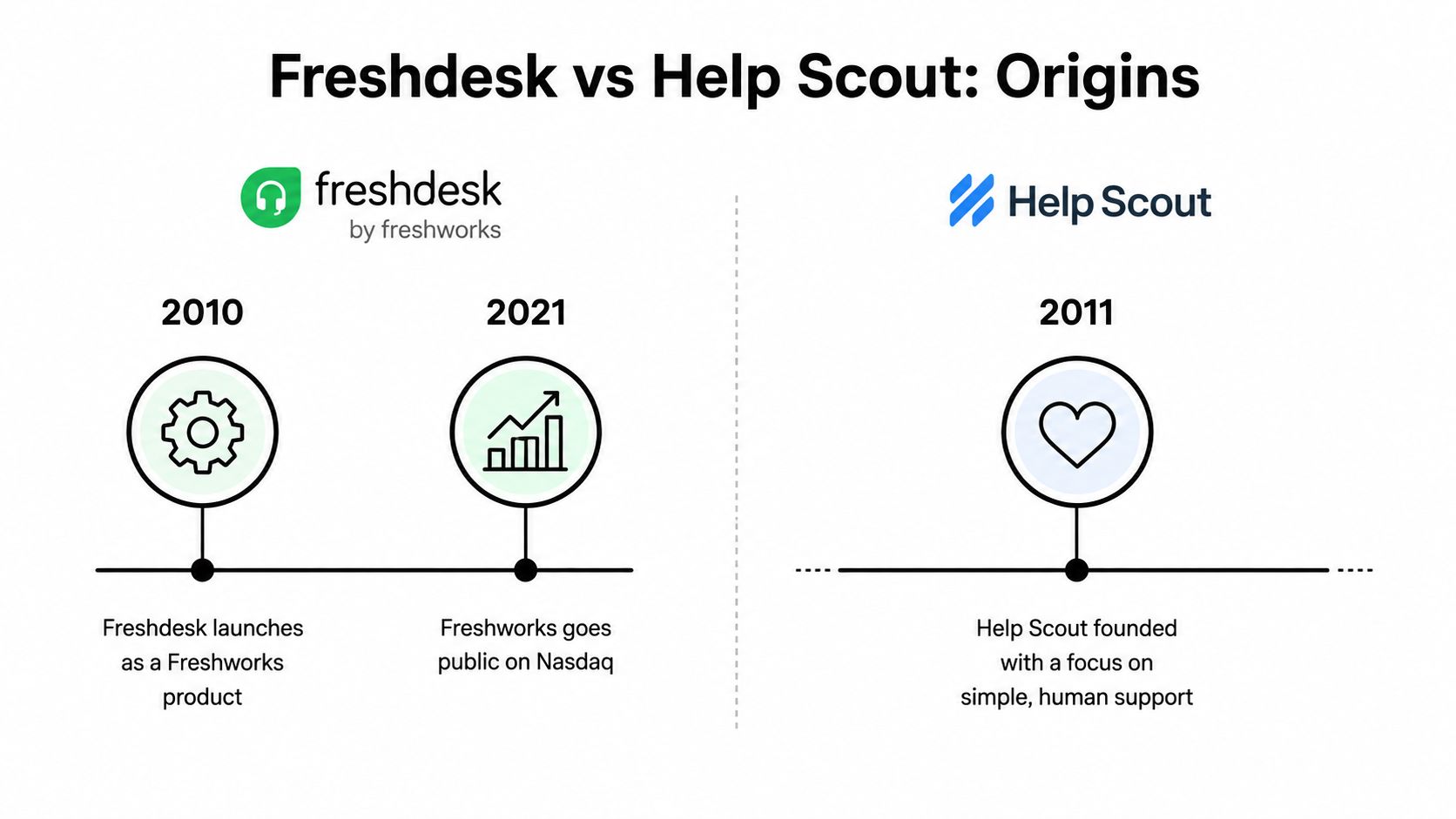
Freshdesk inherited a platform mindset. That's why it leans into routing logic, governance, and multi-layer control when teams get serious about queue management. Help Scout inherited a product philosophy shaped by restraint, so its customer-facing experience and agent workflow stay cleaner, especially for teams that want support to feel human instead of administratively heavy.
That difference is not cosmetic. It changes how fast a team can move, how much training new agents need, and how much operational discipline the platform expects from the people using it.
The customer support software market is still large and expanding. One industry report projects the global market will reach $45.2 billion by 2026 with a 12.4% CAGR from 2021 to 2026, while another projects the customer service software market at $10.95 billion in 2025 and $26.3 billion by 2030 at a 19.1% CAGR (industry market research). The same research says North America accounted for 38% of global revenue in 2023.
Those figures matter because they explain why both vendors keep investing in AI and automation. Teams are not choosing between static products anymore. They're choosing between two evolving support philosophies.
For a deeper operational angle on Help Scout usage patterns, Cometly's analyze Help Scout data page is a useful reference point for teams already instrumenting their support stack.
The cleanest way to compare these tools is to follow the work, not the brochure. Support teams do not live inside “features.” They live inside assignment rules, internal handoffs, channel gaps, knowledge base upkeep, and the annoying little exceptions that turn into process debt.
CapabilityFreshdeskHelp ScoutTicket routingStronger for round-robin, load-balanced, and skill-based assignment on higher tiersSimpler assignment model aimed at lighter operationsComplex queuesBetter for parent-child ticket structures and multi-level governanceBetter when a shared inbox is enoughChannel coverageBroader support stack, including more options beyond emailStrongly centered on email and DocsCollaborationBetter for larger ops that need tighter control over work distributionBetter for fast, low-friction agent collaborationAutomationBroader rule depth for operations that need more branching logicMore curated, easier-to-manage workflowsAIFreddy AI covers a wider support surfaceAI Drafts and Docs AI fit the simpler workflowReportingMore enterprise-oriented dashboards and operational controlReporting stays approachable for smaller teams
Freshdesk's higher-end plans stand out when queue structure matters. Neutral comparison sources note that its Pro and Enterprise tiers support round-robin, load-balanced routing, skill-based assignment, multi-level SLA policies, parent-child tickets, and sandbox environments, while Help Scout lacks skill-based assignment, parent-child tickets, and sandboxing (neutral comparison source). That's the difference between “we can manage support” and “we can govern support.”
Operational takeaway: Freshdesk is the stronger tool when the desk needs control knobs. Help Scout is the stronger tool when agents need to stay fast and customers need the experience to feel simple.
Help Scout's advantage is not raw power, it's clarity. The agent experience stays clean, the customer-facing experience feels less cluttered, and the whole system is easier to adopt without turning onboarding into a project. For teams that spend their day in email and internal notes, that matters more than advanced branching logic.
A practical guide for people migrating from other help desks is the practical guide for Zendesk users, because many of the same workflow tradeoffs show up there too.
Freshdesk, by contrast, is the one to choose when the team already knows the support operation will get denser. It is materially stronger for queue control, and that strength shows up the moment multiple teams, multiple priorities, or multiple SLA layers enter the picture.
If the team wants a broader look at help desk patterns beyond these two products, the best help desk comparison offers useful context on how support stacks evolve as complexity increases.
Sticker price is only useful if the team never grows. That's rarely the case, and it's especially false in support, where headcount, queues, and AI usage tend to rise together. Freshdesk and Help Scout both price in ways that look manageable at the start, then become more revealing once the team adds seats and features.
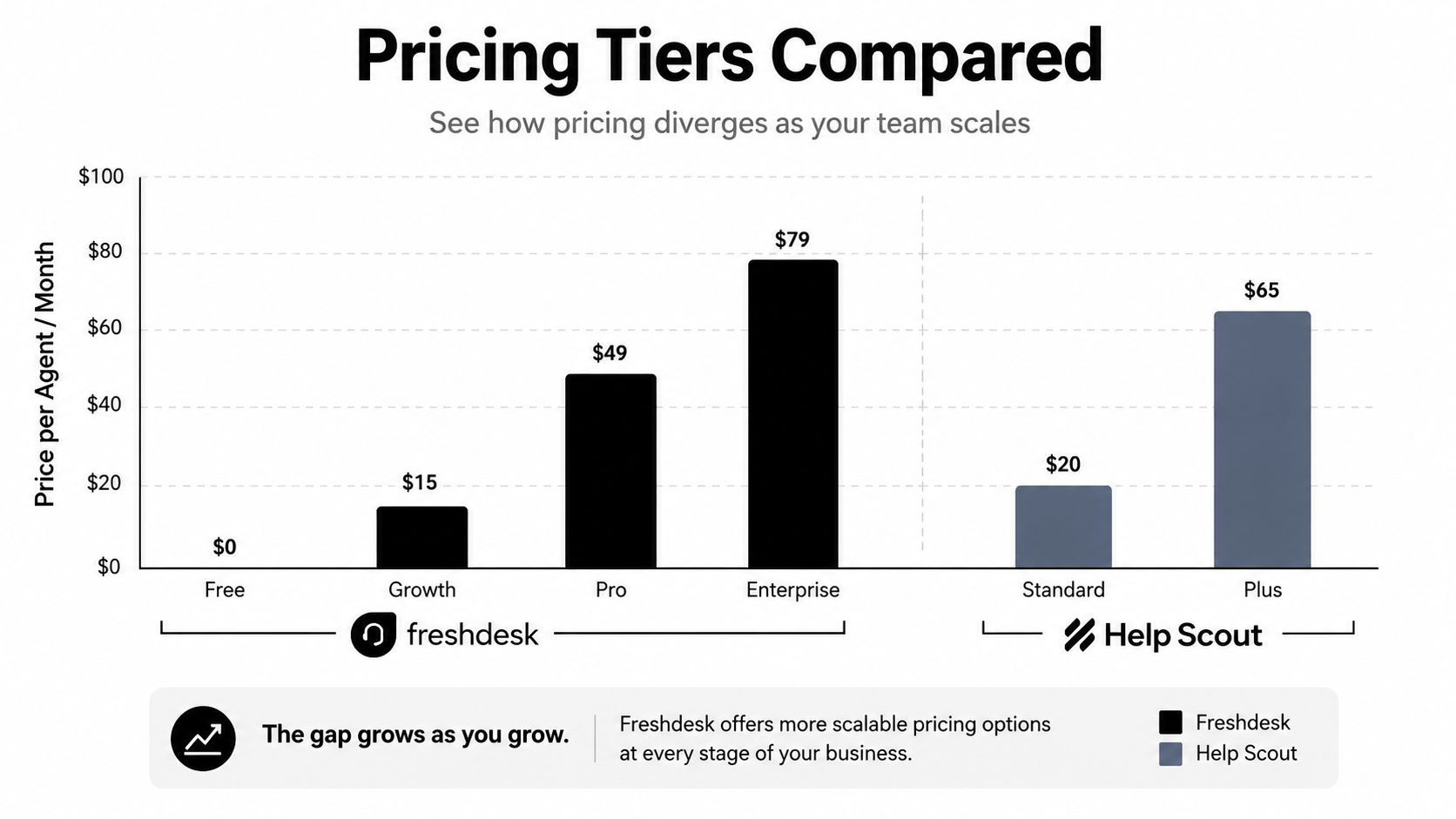
Freshdesk's listed tiers are Free, Growth, Pro, and Enterprise, with the chart above showing $0, $15, $49, and $79 per agent per month. Help Scout's listed tiers are Standard and Plus, shown in the chart at $20 and $65 per user per month. Those figures tell the first half of the story, but not the whole bill.
A 5-person team usually feels the difference most in setup friction and not in absolute spend. Help Scout tends to stay easier to justify for a small group because the workflow stays lighter and fewer feature decisions need to be made up front. Freshdesk starts making more sense when that five-person team already knows it will need more routing control soon.
A 25-person team is where the gap becomes operational, not just financial. At that point, the team is usually paying for process clarity, queue control, and governance whether it wants to or not. Freshdesk's heavier structure starts looking rational, while Help Scout's simplicity can remain attractive if the team's support motion is still mostly email and Docs.
Both platforms now meter AI in ways that can surprise a team that assumes “software price” equals “software cost.” Freshdesk also tends to push more capability into higher tiers or add-on paths, which means the entry plan is only part of the decision. Help Scout's pricing stays friendlier at the base layer, but mailbox and usage decisions can still shape the final bill.
Rule of thumb: if the support stack needs a lot of extras to behave the way the team expects, the cheaper-looking option is often the one that gets expensive first.
For teams evaluating a migration path, the pricing discussion should sit next to the operational one, not replace it. The support migration guide is useful for mapping the hidden work before a switch, because the migration itself is where teams usually discover the cost of a platform change.
Support for community-driven companies rarely starts in email anymore. It starts in Discord threads, Telegram chats, Slack pings, and in-product conversations that need to be handled without losing context. That is where generic help desk advice gets weak, because neither Freshdesk nor Help Scout was originally built as a native community operating layer.
Freshdesk is the better fit when the company wants to centralize multiple support surfaces into one system. It handles traditional help desk work well and gives the team a broader support footprint than Help Scout, but native Discord and Telegram workflows are still not its natural home. Teams usually end up bridging those channels through third-party plumbing, which works, but it is not the same as having the channel built into the operating model.
Help Scout is even more opinionated. It is excellent for email-driven SaaS support teams that care about a polished customer-facing experience and a strong Docs knowledge base. It is a poor fit when most of the actual conversation happens in a chat-native community and the support lead needs public and private conversation handling to stay in sync.
A useful reference point for teams thinking about whether support should also be tied to revenue is this customer support as a profit center piece. The core idea lands here too, because support is no longer just a cost center when it shapes retention, conversion, and community trust.
That last point is where many teams end up reconsidering their stack. If the main problem is not “we need a ticketing system,” but “we need to handle community conversations without breaking context,” then a help desk built around tickets is only solving part of the issue.
Mava fits that gap as a unified support layer for community-driven companies. It handles conversations across Discord, Telegram, Slack, web chat, and email in one shared inbox, so teams do not have to force a chat community into a traditional ticket model.
The cleanest migration treats support as a process change, not a software install. Teams that rush the cutover usually find the missing pieces in production, which is the worst time to learn that a routing rule, help center redirect, or identity setting was overlooked.
Start with a full workflow audit before any move. Review SLAs, custom fields, automations, collision handling, views, tags, integrations, and the internal rules agents use without thinking about them. If you support Discord, Telegram, or other community channels, check how those conversations will be preserved and re-routed too.
Some migration failures look like software bugs, but they are really field-mapping mistakes that nobody checked early enough.
Reconnect channels in the right order, and do not start with the noisiest one. Keep inbound volume predictable while the team validates ticket flow. Once customers start entering the wrong queue, the support calendar stops being about cutover and turns into recovery.
Freshdesk wins when the support operation is already complex or clearly heading there. It is the better choice for teams that need complex routing, multi-level SLAs, sandbox testing, and a broader channel mix, and it makes the most sense when there's actual ops capacity to manage a heavier platform. The product's value shows up when governance matters as much as speed.
Help Scout wins when the team wants a simpler life. It fits email-first support, Docs-driven self-service, and a smaller or mid-sized team that cares as much about the customer-facing experience as it does about internal workflow control. It is the cleanest answer for teams that want support to feel human and uncluttered.
That said, a support desk is not always the right answer. If most of the volume comes from Discord, Telegram, or Slack, and the team wants AI-first automation without forcing community conversations into a ticket queue, then neither Freshdesk nor Help Scout is the ideal center of gravity. In that case, a community-native system is the better fit, and the Help Scout alternatives for SaaS communities discussion is a useful place to compare models that were built for that reality.
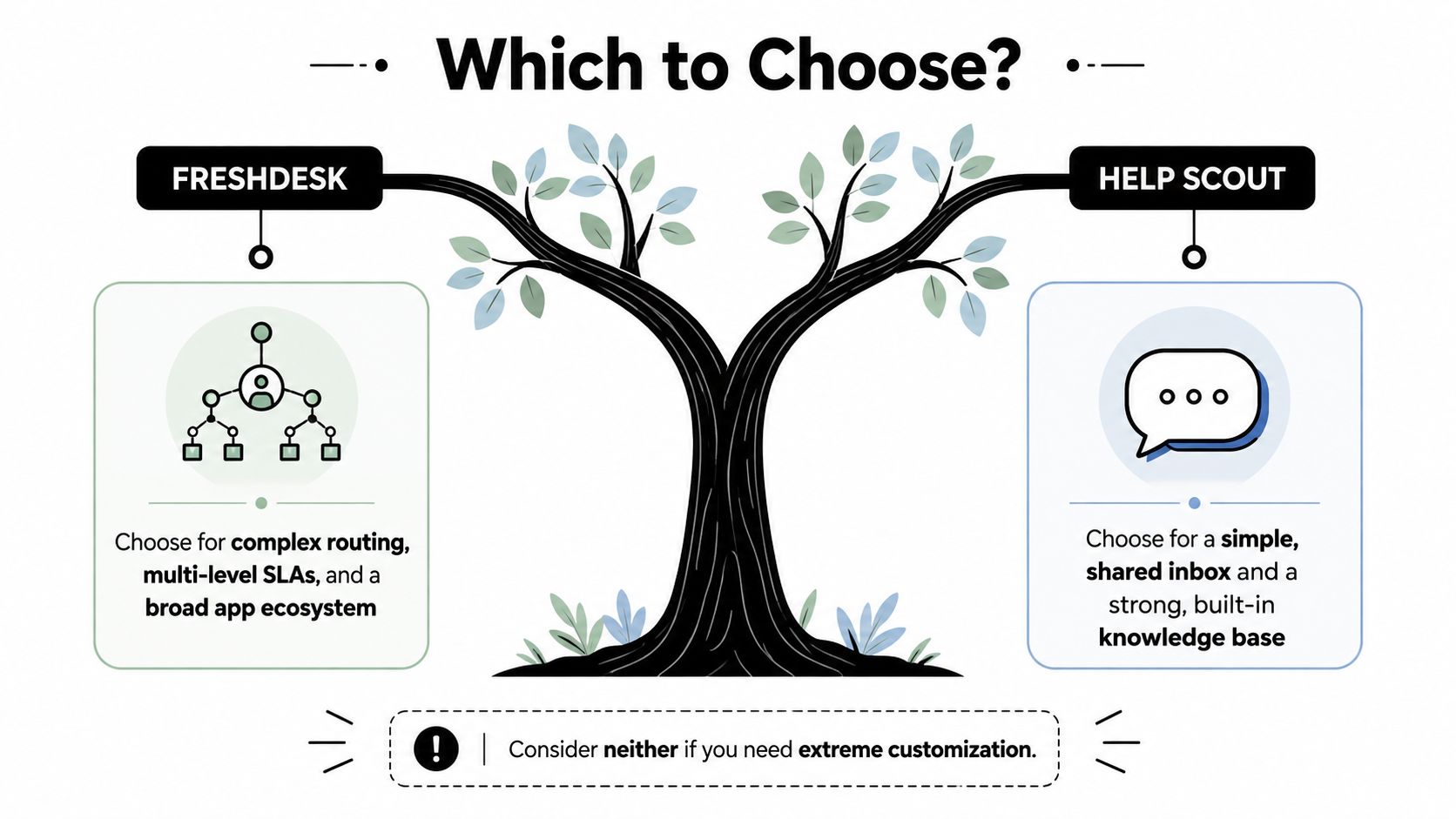
Pick Freshdesk if the support desk is becoming an operation. Pick Help Scout if the support desk is staying lean and email-centric. Pick neither if the actual job is managing a living community across chat channels, because that problem needs a different kind of product.
Mava is built for teams that need support across Discord, Telegram, Slack, web chat, and email in one shared inbox. If the Freshdesk vs Help Scout decision is really about how to support a community-driven company without losing context, visit Mava and see how a channel-native support workflow changes the equation.
.png)
.png)
.png)
