.png) Get Started
Get Started
You're probably at the point where the inbox still works, but the cracks are obvious. Agents are reassigning the same thread twice, customers are asking the same question in chat, email, and your community channel, and someone on the team is trying to decide whether the next platform should be built around messaging or around tickets.
That's the intercom vs zendesk decision in 2026. Both are mature, widely used customer experience platforms, and both still matter at scale, with Zendesk slightly ahead in broad market snapshots at 14.11% versus Intercom at 13.27% of the customer experience market in one 2026 dataset, a gap of less than one percentage point (SQ Magazine's Zendesk statistics summary). The choice is rarely about which product is “better” in the abstract. It's about which operating model fits the way support runs.
Decision areaIntercomZendeskCore DNAMessaging-first, conversational supportTicket-first, structured supportBest fitProduct-led teams, in-app help, faster deploymentComplex queues, governed workflows, enterprise routingAI cost shapeSeat-based plans with add-onsUsage-based Fin AI at $0.99 per resolution (Zendesk comparison)Integration breadthSmaller ecosystemRoughly 1,800 apps in independent comparisons (Featurebase comparison)Workflow depthLighter and faster to stand upStronger for SLAs, routing, and data plumbing
The core trade-off is simple: Intercom tends to reward teams that live in conversation. Zendesk tends to reward teams that live in queues, rules, and escalation paths.
A support lead usually meets this choice after growth makes the old setup awkward. The team starts in chat, adds email, then bolts on automation, and customer issues begin to look different depending on where they entered. One side wants speed in the messenger. The other wants ticket discipline. Both needs are real, and that is why this comparison still matters.
Intercom and Zendesk are now mature platforms, not early-stage tools with uneven depth. Intercom launched in August 2011 with a messaging-first model, while Zendesk started in 2007 in Denmark, went public in 2014 after raising $85 million before its IPO, and was later acquired in June 2022 in a $10 billion deal led by Hellman & Friedman and Permira. Those histories shape the products today. Zendesk grew around support operations. Intercom grew around product communication.
That heritage shows up in daily work. Intercom usually fits faster when support starts inside the product, especially for teams that want conversational service, onboarding, and proactive messaging in one place. Zendesk usually fits better when the operation needs formal routing, governed workflows, and clear separation between open work, waiting states, and resolution paths.
Intercom keeps the customer in a conversation. Zendesk moves the issue through a process.
If your support team spends more time orchestrating work than chatting with customers, Zendesk's structure usually pays off. If your support motion is mostly real-time conversations, Intercom's model often feels lighter.
The right choice also depends on total cost at scale, not just seat pricing. AI resolution rates, ticket volume, and the amount of human handling left after automation all change the cost curve. Channel fit matters too. Teams running support in Discord, Telegram, or Slack need to know whether the platform supports that workflow cleanly or forces those conversations into a help desk model that was built for something else.
Contrary's Intercom company profile provides the company history behind Intercom's product direction.
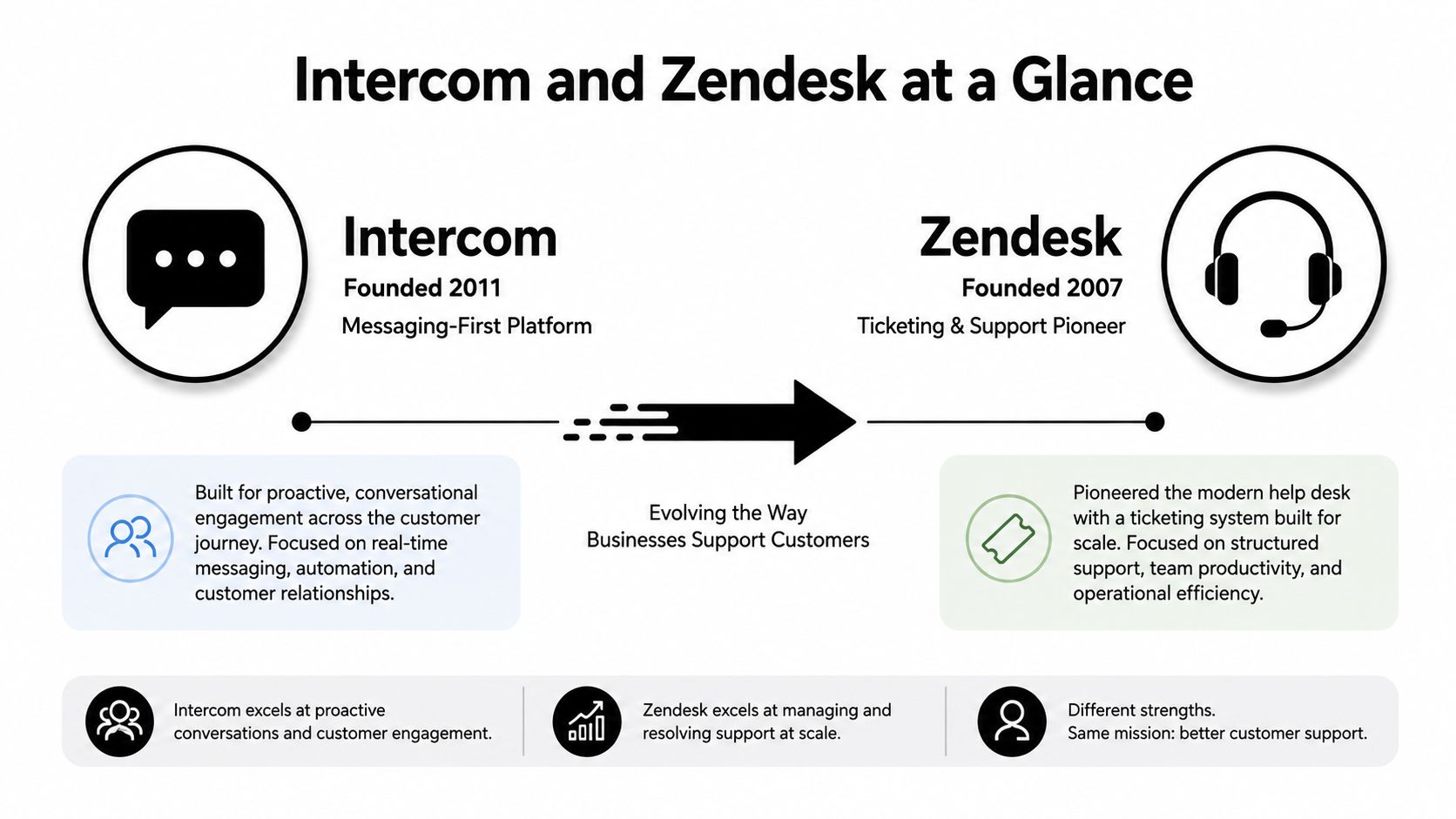
Intercom was founded in August 2011 by Eoghan McCabe, Des Traynor, David Barrett, and Ciaran Lee, and marked its 10-year anniversary in 2021. Its timing matters because it was built in the modern SaaS era, when messaging, in-app communication, and product-led growth were already shaping support expectations. That origin still shows in the product.
A support team usually feels that difference on day one. Intercom works well when the first customer touch happens inside the app, and the team needs onboarding messages, live chat, and conversational support to sit in the same workflow. It is a better fit for teams that care more about keeping the exchange fluid than enforcing a formal ticket path.
Zendesk was founded in 2007 in Denmark, became public in 2014 after raising $85 million before IPO, and was acquired in June 2022 in a $10 billion deal led by Hellman & Friedman and Permira. That longer run as a public software vendor gave it a different operating shape, and the platform still reflects an enterprise support mindset.
The practical effect shows up in queue design and handoffs. Zendesk usually fits teams that need tiered routing, SLA pressure, and multi-step ownership changes, especially when support work has to stay visible across agents and departments. It also makes more sense when the help desk must connect to a wider stack, which is why teams comparing support tools often look beyond feature lists and review adjacent systems too, including a SaaS social media tool comparison when they are mapping how many channels and tools the operation should keep under one roof.
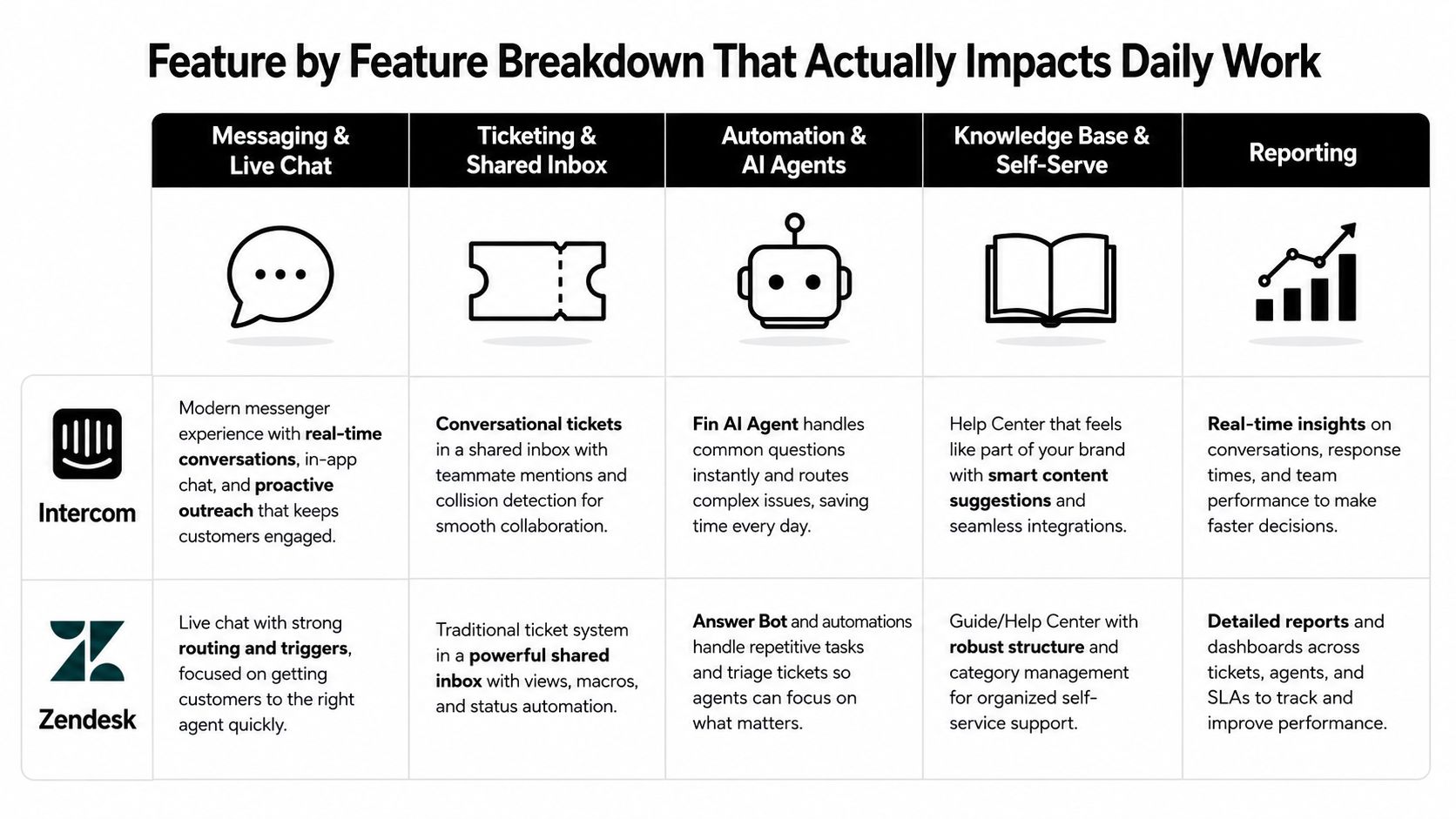
The question is how each platform changes the day-to-day flow when queues are full, customers want fast answers, and engineering needs clean context. That is where support software either reduces friction or adds more work.
Intercom keeps the exchange conversational, which suits product-led support and teams that expect the first contact to happen inside the app. Zendesk is built around a ticket object, so ownership, routing, and queue discipline stay explicit. That structure helps when work has to move cleanly across agents or departments.
The trade-off is workflow shape. Intercom keeps the agent close to the conversation thread, while Zendesk gives operations a clearer framework for handoffs and tracking.
Zendesk's published comparison puts Fin AI agent at $0.99 per resolution, while Intercom packages AI differently through seat-based plans and add-ons (Zendesk vs Intercom comparison). That means the cost question is not just what a plan starts at, but how much work the AI resolves.
If resolution volume is high and predictable, Zendesk's usage-based shape can be easier to justify. If the team wants a more fixed monthly structure, Intercom is simpler to forecast until automation becomes a larger part of the workload.
Independent comparison pages show Zendesk with roughly 1,800 apps versus about 450 to 350 for Intercom depending on the source (Featurebase comparison). The gap matters because it changes how much process can live inside the help desk instead of being stitched together outside it.
Zendesk usually fits teams that need more routing across external systems and heavier back-office coordination. Intercom tends to get teams running faster when messaging is the main channel and the workflow stays narrower.
Practical rule: if the support team relies on many downstream systems, Zendesk usually absorbs that complexity better. If the team mainly needs fast, clean customer conversations, Intercom usually feels lighter.
Discord, Telegram, and Slack do not behave like standard support channels. They move quickly, carry a lot of context, and often mix public conversation with individual customer issues. Intercom's conversational model can sit closer to that style of work, especially when the goal is live replies and embedded messaging.
Zendesk is a better fit when those same community questions need to become governed cases with routing, ownership, and auditability. For teams comparing broader help desk options, the best help desk comparison is a useful adjacent read because it shows how different systems handle service workflows beyond a single inbox.
CapabilityIntercomZendeskMessaging and live chatStrong conversational experience, especially in-productSolid messaging, but less native to product-led flowsTicketing and shared inboxConversation-first, with tickets as a later layerTicket-first, built for queues and structured ownershipAutomation and AI agentsEasier to package into the messaging workflowBetter fit for usage-based AI economics and larger operationsKnowledge base and self-serveTightly connected to the messenger experienceMore mature for broad support operations and governanceReportingEasier to read, lighter operationallyDeeper, more suitable for complex support oversight
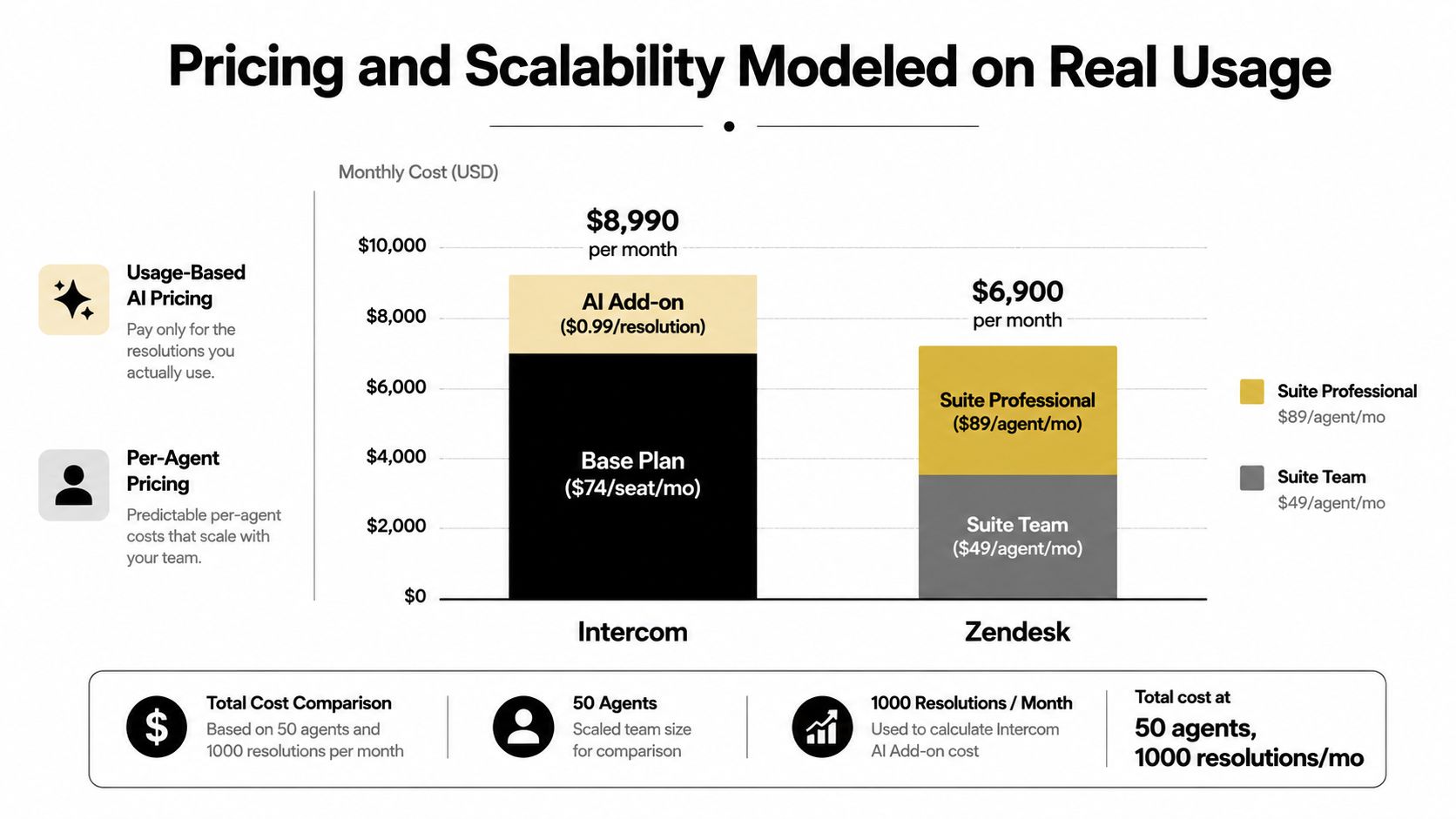
A pricing decision that starts with seat counts usually misses the bill. Support cost changes as ticket volume rises, AI absorbs more or fewer contacts, and escalations move work back to humans. That makes ticket volume, automation hit rate, and escalation rate better inputs than headline plan prices.
Zendesk's comparison frames Fin AI agent at $0.99 per resolution. Intercom uses a different pricing shape, with seat-based plans and add-ons instead of the same usage line. The practical question is not which vendor looks cheaper on a landing page, but which cost structure matches how often AI closes work. If resolution rates are high and steady, a usage-based model can be easier to justify. If the team sees predictable support patterns, every resolved contact needs to be counted carefully.
Intercom is easier to forecast for small teams or messaging-heavy workflows because the seat structure is clearer at the start. Once automation begins handling real volume, the add-on layer changes the monthly total. That is why some teams label Intercom as cheaper early on and then revise that view after usage climbs.
Budgeting rule: compare the system at your real support volume, not at the starting tier.
Naming also affects cost analysis. Clear ticket categories make reporting cleaner, which helps teams separate true deflection from cases that were just routed differently. That is where email subject line formatting becomes a useful analogy for support operations, because consistent labels reduce noise in handoffs and reports.
Start with three variables.
For a low-volume inbox, seat price will dominate the decision. For a team handling repetitive questions, AI resolution cost becomes the line item to watch. For an operation with many edge cases, the cheaper platform on paper can still cost more in practice if humans keep taking over the work.
Recent market-share snapshots still show both products as durable category players, with Zendesk at 14.11% and Intercom at 13.27% in one 2026 dataset, which suggests the decision is happening in mature environments rather than among tiny teams (SQ Magazine). That matters because mature teams have already felt the cost of workflow mismatch. They aren't buying a feature set. They're buying an operating shape.
These teams need fast acknowledgment, human context, and a way to keep public questions from turning into private chaos. Intercom can work when the support motion looks like conversational moderation and product chat. Zendesk starts to make more sense when those threads need formal ownership, SLA tracking, and escalation to other departments.
Verdict: if the team's world is mostly conversational and the channels stay close to the product, Intercom is the cleaner fit. If the community channels feed into a larger support organization, Zendesk is safer.
Intercom usually fits here first. The messaging layer aligns with product-led onboarding, and the customer sees help inside the experience rather than being pushed into a separate support portal. Zendesk can absolutely run the same workload, but it usually asks for more structure up front.
These teams deal with bursty, public, repetitive questions. Intercom handles the immediate conversation well, especially when support is tightly linked to the game or launcher experience. Zendesk is stronger when issue tracking, billing questions, and technical handoffs need to stay organized across multiple internal teams.
Web3 support often mixes public community channels with account-specific or transaction-sensitive questions. Intercom is useful when the team needs speed and direct messaging. Zendesk becomes the better back-end once the team needs routing discipline, auditability, and a broader service structure around the community firehose.
Across all four profiles, the same pattern shows up. Intercom wins where speed and conversational clarity matter most. Zendesk wins where work needs to be systematized before it can be solved.
Moving platforms is not just a data import. Support leaders have to rebuild business rules, keep customer history usable, and verify that routing still works when tickets start flowing on day one. The more layers a workflow has, the more deliberate the cutover has to be.
Migration risk usually comes from fit, not from export tools. Zendesk tends to suit operations with many connected systems and formal handoffs, while Intercom is easier to stand up when the migration is mostly about conversational support and fewer dependencies. That planning matters because the platform choice shapes how much has to be recreated before launch.
A useful migration plan still comes down to a few checkpoints.
For teams planning a move, the support migration guide is a practical reference for data, workflow, and channel transitions before go-live.
Performance also depends on how much support lives outside the ticket queue. Teams handling Discord, Telegram, and Slack often need routing that keeps public context and private follow-up tied together. That is where general help desk migrations get messy, because the ticket system may import cleanly while the community workflow still needs manual glue.
AI changes the scope as well. If automation is part of the migration, the mid-market B2B AI support guide is useful because AI resolution rates, escalation patterns, and human handoff rules affect both implementation effort and ongoing load. In practice, the trade-off is simple. Faster deployment lowers upfront friction. Tighter workflow control reduces operational drag later.
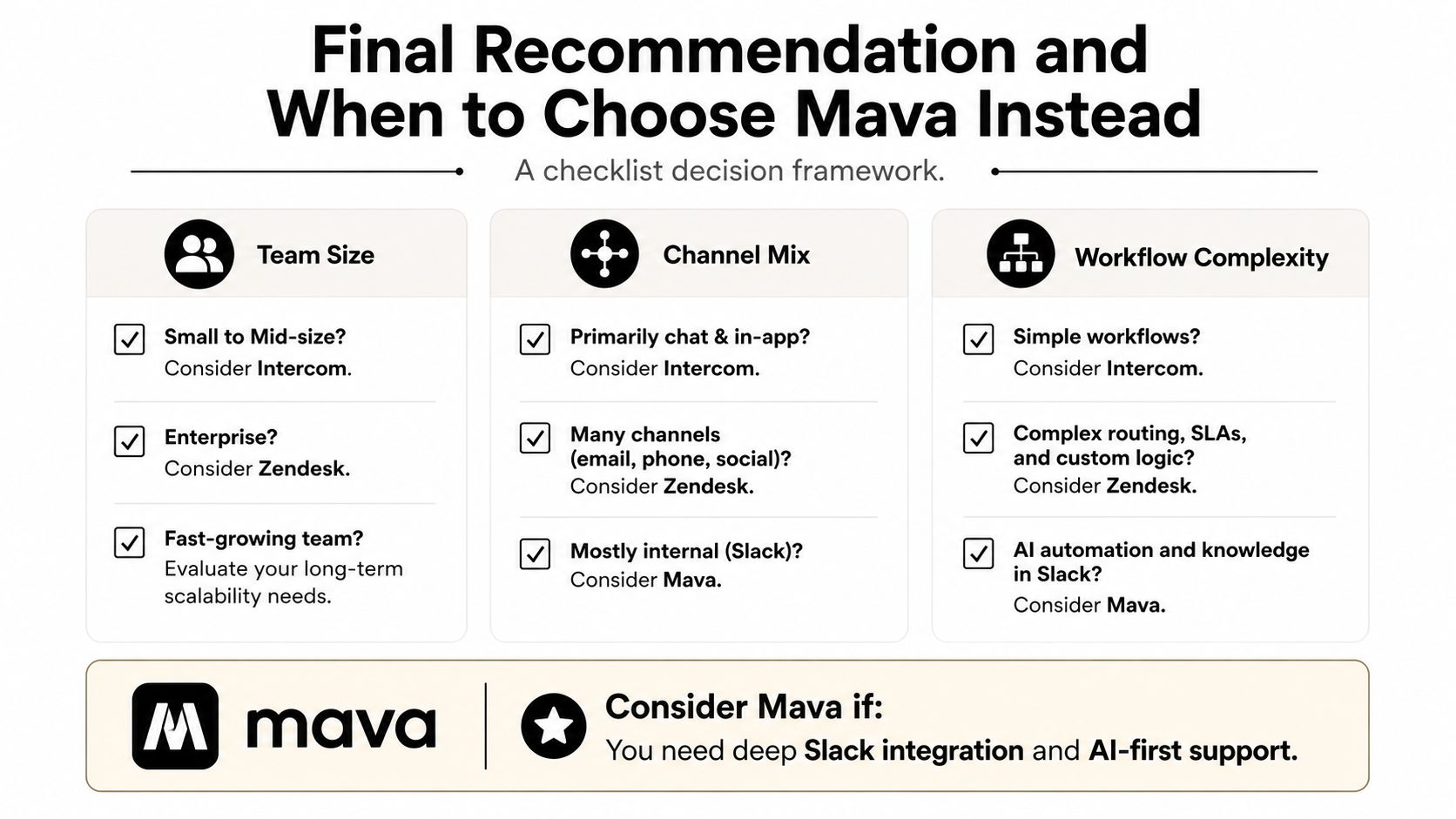
The right choice depends on how support runs.
Teams that spend support time in Discord, Telegram, Slack, web chat, and email often need a different setup. Mava fits that community-heavy model, with a shared inbox, AI that can hand off to humans, and workflows that keep public and private context tied together. For teams weighing that route against a ticket-first stack, the Mava vs Zendesk comparison is a useful next read.
Mava is a community-focused support platform for teams that need to manage support across Discord, Telegram, Slack, web chat, and email without losing context. If your intercom vs zendesk decision is really about community channels, AI handoff, and shared workflows, visit Mava and see whether a community-native support stack fits the way your team already works.
.png)
.png)
.png)
