.png) Get Started
Get Started
The usual advice says Gorgias for ecommerce and Zendesk for enterprise, then stops there. That shortcut misses the harder question support leaders are answering in 2026, which platform gets more expensive as AI succeeds, and which one still works when support spills into community channels, not just email and chat.
That matters because modern support teams don't live inside a single inbox anymore. They're juggling storefront tickets, social replies, private messages, and public community conversations, and the cost model underneath the helpdesk can change as automation removes more repetitive work.
PlatformPricing modelEntry planMid-tier planCost per unitGorgiasBillable ticket$10/month for 50 tickets$360/month for 2,000 ticketsAbout $0.15 per included ticket on annual billing, per comparison dataZendeskAgent seat$19/agent/month$55/agent/monthSeat-based pricing on annual billing, with higher tiers at $115/agent/month
The old framing worked when the choice was mostly about storefront support. Gorgias was the obvious fit for merchants who wanted an ecommerce-native inbox, and Zendesk was the default for larger support teams that needed a broader operating system. That story is still partly true, but it no longer explains the purchase decision.
Support teams now need to think about channel mix, automation depth, and billing behavior under success. A team running Discord moderation, Telegram support, and email tickets has very different needs from a team handling order status questions inside a Shopify store. The same tool can look cheap or expensive depending on whether the team is paid by the seat or by the ticket.
Practical rule: if automation reduces human handling but increases the number of billable resolutions, the pricing model matters more than the feature checklist.
That is why the simple ecommerce-versus-enterprise split falls apart. Gorgias still aligns closely with ecommerce workflows, while Zendesk stays broader and more general across industries, but support leaders need to ask what happens when the helpdesk has to carry public conversations, non-retail requests, and internal routing in the same system. The right choice depends on whether the operation is mostly transactional, or whether it is relationship-driven and community-facing.
AI also changes the economics in a way many buyers underestimate. If the platform charges per ticket or per resolution, more automation does not automatically mean lower cost. In some cases, it means the opposite, because successful deflection creates more billable events.
That hidden dynamic sits behind gorgias vs zendesk in 2026. The wrong comparison is which one starts cheaper. The useful comparison is which one stays predictable when volume rises, support becomes more automated, and the team's mix of channels gets wider than the original storefront.
The pricing difference looks simple on paper. Gorgias charges by billable ticket, while Zendesk charges by agent seat. In practice, that choice changes how each platform behaves as support teams grow, especially once AI starts resolving a larger share of the queue.
Gorgias' published plans in the comparison data start with Starter at $10/month for 50 tickets, move to Pro at $360/month for 2,000 tickets, and Advanced at $900/month for 5,000 tickets (Richpanel comparison). Zendesk's comparison pricing is seat-based, with Support Team at $19/agent/month, Suite Team at $55/agent/month, and Suite Professional at $115/agent/month on annual billing (Richpanel comparison).
That means Gorgias can look attractive for high-ticket, low-seat operations, while Zendesk tends to feel steadier for larger teams that want costs tied to staffing rather than conversation volume. One analysis in the brief estimates Gorgias Pro at about $0.15 per included ticket on annual billing and places crossover points at roughly 370 tickets per agent per month versus Zendesk Suite Team and about 770 tickets per agent per month versus Zendesk Suite Professional (Richpanel comparison). Those are planning markers, not a universal verdict.
The counterintuitive part shows up when automation improves. Gorgias still counts tickets, so if AI resolves more conversations, the bill can rise with the same success buyers are trying to buy. Zendesk's seat-based model does not behave the same way, which is why support leaders often see it as easier to forecast as volume rises.
A 2026 comparison says Gorgias AI lands around $1 per automated resolution, while Zendesk Copilot is described as a flatter $50 per agent add-on and AI agents at roughly $1.50 to $2.00 per automated resolution in annual pricing tables (Engaige comparison). Another independent economics summary says Gorgias prices AI at about $0.90 to $1.00 per resolution, versus $1.50 to $2.00 on Zendesk (Gorgias comparison). The exact number depends on the vendor table and the contract, but the cost shape stays the same, resolution-based pricing grows with success.
For teams trying to forecast spend, a published annual pricing view like Vision annual pricing is a useful reminder to compare the annual bill, not just the entry plan. That is the only way to estimate what a busier support queue will do over time.
Bottom line: ticket-metered pricing rewards low volume and gets expensive when automation drives more resolved conversations. Seat-based pricing usually feels less exciting, but that predictability matters when support throughput keeps growing.
For a broader vendor shortlist, the best help desk comparison guide is useful when teams want to see where Gorgias and Zendesk sit among other support stacks.
PlatformPricing ModelEntry PlanMid-Tier PlanCost Per UnitGorgiasTicket-based$10/month for 50 tickets$360/month for 2,000 ticketsAbout $0.15 per included ticket on annual billingZendeskSeat-based$19/agent/month$55/agent/monthCost scales by agent seat, not ticket volume
The key planning question is not which plan looks cheaper on day one. It is whether your queue will get more efficient without getting quieter. If the answer is yes, the pricing model deserves close scrutiny.
The biggest mistake in this comparison is treating AI as a feature checklist. The operational question is whether automation fits the way your team works, and whether its economics hold up as volume rises. Gorgias is tuned for ecommerce actions and repetitive store workflows, while Zendesk is built around broader support operations, with AI sitting inside deeper reporting and workflow layers.
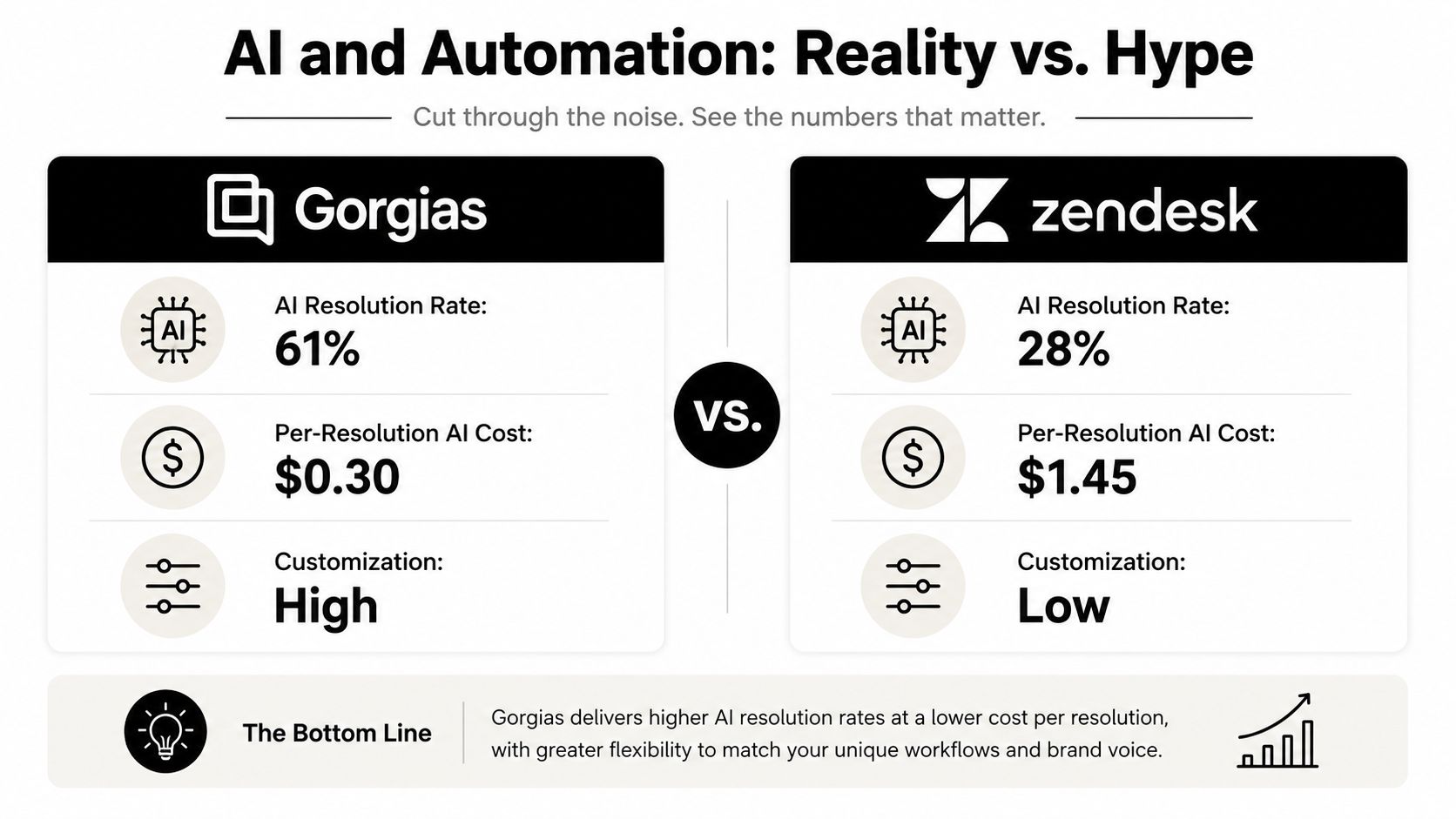
One independent comparison says Gorgias markets up to 60% of inquiries as instantly resolved, but also notes third-party review caps automation around 60% of email and chat, with named case studies much lower, including Psycho Bunny at 26% (Engaige comparison). Zendesk says its agents routinely resolve over 80% of interactions, but that figure is presented as platform-wide rather than ecommerce-specific.
Those numbers are ceilings and operating contexts, not promises. Gorgias is the more commerce-specific system, so its automation tends to fit order tracking, refunds, and store actions. Zendesk's figure reflects a broader support estate, so it should not be treated as a like-for-like store benchmark.
The same 2026 comparison says Gorgias AI is priced around $1 per automated resolution on top of ticket fees, while Zendesk Copilot is framed as a $50 per agent add-on and AI agents as roughly $1.50 to $2.00 per automated resolution. Another independent summary describes Gorgias AI at about $0.90 to $1.00 per resolution and Zendesk at $1.50 to $2.00 (Gorgias comparison).
That gap matters most when the queue gets large. A support team that clears more repetitive tickets with AI is doing the right thing operationally, but on a ticket-metered platform, every successful resolution can still create billing pressure. Zendesk's seat model avoids that specific feedback loop, though its AI costs still need modeling because the resolution layer sits alongside the seat charge.
For teams building automation on top of live support data, a tool like the Web Scraping API for RAG can help centralize source material for retrieval-heavy workflows. The point is not the tool itself, it is that AI only performs well when the underlying knowledge and commerce data are current.
Gorgias is strongest when the workflow is tightly tied to ecommerce behavior, especially if agents need to act quickly inside store operations. Zendesk is better suited to broader triage, reporting, and governance, particularly where support spans multiple departments and more structured policy handling.
AI should be tested against real tickets, not demo prompts. A clean answer in a sandbox means very little if the live catalog, order history, or policy exceptions are not available at the moment of resolution.
For teams mapping the automation layer before they choose a platform, the how to automate customer support guide is useful as a practical reference. The right question is not whether AI can reply. It is whether it can close the loop without creating more work downstream.
Support now stretches past an inbox and a chat widget. Community-driven teams have to handle Discord threads, Telegram messages, social replies, web chat, and email at the same time, with different tone, urgency, and visibility rules for each one.
Zendesk's published comparison says it supports voice, email, social media, community forum, custom reports, skills-based routing, and a broader integrations catalog and rating system, while Gorgias lacks or only partially supports those capabilities in the same matrix (Zendesk comparison). That matters when support has to cover community moderation, private case handling, and multi-department escalation without forcing everything into a single inbox pattern.
The same comparison also shows Zendesk with a stronger omnichannel posture, including phone, SMS add-ons, and broader social channel coverage. Gorgias does centralize channels into a shared inbox, but the comparison matrix and product notes point to more limited depth, especially around voice and broader social support.
Gorgias still fits teams built around ecommerce workflows, especially when the support load is mostly transactional. Its strength is speed inside a narrower operating model. For brands whose customer conversations usually begin and end with the order, that can be enough.
The trade-off appears once support starts mixing customer care with community management and internal coordination. A public forum, private tickets, and side-channel follow-up all create different context requirements, and the platform has to preserve that context without forcing agents to switch mental models every few minutes.
For teams comparing automation vendors across the rest of the stack, workflow automation services by AY Automate can be a useful reference point. Support automation is not only about faster replies, it is about moving information cleanly between channels and teams, especially when AI starts touching more of the workflow.
A platform can be excellent at private ticket handling and still feel clumsy the moment a public community layer gets added.
That is the practical split. Zendesk is usually the safer bet when the support perimeter keeps expanding. Gorgias makes more sense when the channel mix is simpler and the operational goal is fast handling of product and order questions.
As teams grow, basic inbox features stop being the deciding factor. Reporting, routing, and customization become the essential operating layer, because managers need to see patterns, not just move messages around.
Zendesk's comparison matrix shows custom reports, skills-based routing, ticket forecasting, a community forum, and a broader integrations catalog and rating system, while Gorgias lacks or only partially supports those capabilities in the same comparison. It also lists Zendesk with custom metrics, stronger reporting, and ticket forecasting, while Gorgias comes in weaker on advanced analytics and workforce-management depth.
That difference matters more as support splits across regions, products, and channel types. Skills-based routing is not a nice extra, it keeps the right tickets from landing with the wrong person in the first place. For community-driven teams, it also matters that the system can preserve context across public discussion spaces and private follow-up without turning routing into a guessing game.
The same matrix shows Gorgias holding up on macros, SLA management, side conversations, and custom fields, so it is not a bare-bones product. The limitation is depth, not presence. When teams need advanced analytics or workforce planning, the ceiling shows up sooner.
The comparison also notes that Gorgias is more limited on shared workspace customization and reporting inside the app, with some data needing export for deeper analysis. That is workable for smaller operations that care most about speed. It becomes a constraint when leaders need a live view of channel behavior, staffing patterns, and workflow bottlenecks across email, chat, community, and other support surfaces.
Operational test: if a manager cannot answer “why did this queue spike” without exporting data first, reporting depth is probably too shallow for the team's next stage.
For small teams, that gap may never matter. For larger teams, it gets expensive because every blind spot turns into manual investigation, and manual investigation is slow every time support volume shifts.
The cleanest answer is still contextual. Different companies can justify different tools for good reasons, and the wrong choice usually comes from copying someone else's operating model instead of matching the software to the channel mix.
Gorgias is the cleaner fit for pure ecommerce stores that want support tied tightly to order activity. It also fits teams where the queue is repetitive, the channel set is narrow, and the team wants a ticket-metered model that can stay efficient while complexity is still low.
That advantage narrows once support starts looking more like operations than store service. If the business begins handling partner requests, community moderation, and multi-region escalation, Gorgias's ecommerce focus can turn into a constraint instead of a strength.
Zendesk is usually stronger for SaaS companies, enterprise support teams, and any operation that needs richer routing, reporting, and governance. It also makes more sense when support leaders need voice, broader omnichannel handling, and deeper operational controls than an ecommerce-first tool usually provides (Zendesk comparison).
The same logic applies to gaming studios and Web3 projects with active communities. Those teams often deal with public questions, private account issues, and large volumes of repetitive support, so the software has to manage more than storefront tickets. A platform that can hold that mix together without forcing every conversation into the same queue usually becomes the safer operational choice.
Community-led companies often need a helpdesk that can unify Discord, Telegram, Slack, web chat, and email in one place. In those cases, a community-native platform like Mava is one of the options worth evaluating, because it is built around a shared inbox for public and private tickets rather than being adapted from a storefront support model.
That distinction matters most when support and community management overlap. If the team's day is spent moving between moderation, product help, and customer success, the helpdesk should fit that reality instead of forcing it into an ecommerce template.
The decision starts with the work the team does every day. If most volume comes from order issues, product questions, or community conversations, that shapes the platform choice more than brand reputation does. Who needs access matters just as much. Some teams only need support in the queue, while others need support to work alongside community, product, and success teams. AI also needs a hard look. It should reduce labor without turning into a cost line that grows faster than the savings. Reporting and routing are the final filter, because a lighter inbox can cover simple intake, but it will struggle once the operation needs more control.
Zendesk's broader governance and routing can justify the heavier setup for some organizations, while Gorgias's narrower scope can make it faster to launch. The trade-off becomes more visible once AI is doing real work, because ticket-metered and seat-based pricing behave very differently as automation scales. A ticket-based model can feel efficient early on, then become harder to predict as volume shifts. A seat-based model is easier to understand, but the cost can rise even when automation reduces manual effort. Teams should model both the support load and the AI layer before deciding which one fits the operating plan.
The channel mix matters too. Community-driven teams often need to keep Discord, Telegram, Slack, web chat, and email connected to the same support process, and that is where traditional helpdesks can start to feel narrow. Support migration planning is useful here because every platform change carries process risk and data risk, so it often makes sense to test whether automation or a community-native inbox can solve the problem before replacing the core system.
If the support model already depends on Discord or Telegram, the decision is not only about moving tickets. It is about whether the new stack can preserve context across the channels where users actually show up.
For community-first teams, that question can matter more than the feature checklist. For ecommerce-heavy teams, Gorgias or Zendesk may still be the right answer, but only after the team has mapped volume, AI costs, routing depth, and the channels that carry the workload.
.png)
.png)
.png)
